 Berlin WW2 Tours
Stolpersteine in Berlin: What They Are and How to Find Them
Stolpersteine in Berlin are small brass-capped memorial cubes set into the pavement in front of the last freely chosen homes of Nazi victims. More than 11,000 of them lie in this city alone, which makes the German capital one of the best places to encounter the project. This guide explains what a Stolperstein is, how to read the inscription, how to find stones near where you are staying, and how to behave when you stop at one. It also points to bookable walks, such as the historian-led Third Reich tour, that set the stones in their wider context among Berlin WW2 tours. The bookable tours are compared on World War II tours in Berlin.
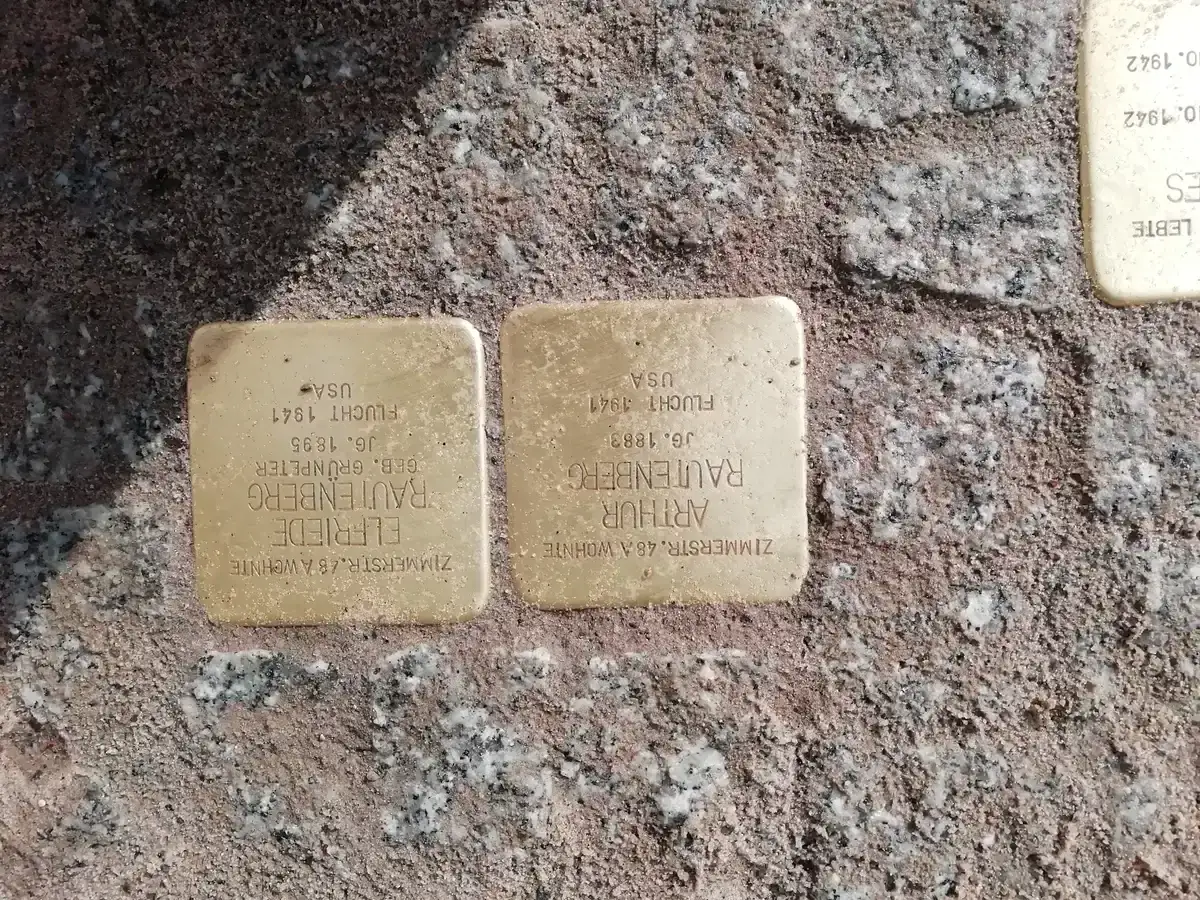
Two brass Stolpersteine set into the pavement in Berlin-Mitte. Photo: Berihert, CC BY-SA 3.0, via Wikimedia Commons
Quick answer Stolpersteine at a glance
More than 11,000 Stolpersteine lie in Berlin's sidewalks, each a 10 cm concrete cube topped with a brass plate that reads 'Hier wohnte', meaning 'here lived'. The artist Gunter Demnig began the project with the first stone in Cologne on 16 December 1992. By June 2023 more than 100,000 stones had been laid in over 1,200 towns and cities.
Key takeaways
- Read what the inscription means and how the project grew in the guide to what a Stolperstein is.
- Berlin's coordination office for the stones sits at Stauffenbergstraße 13-14, and its details are in the section on finding them.
- For background on the Nazi era, the historian-led walk covers nine sites with at most 10 guests for $51.
- For the central Holocaust memorial with its roughly 2,700 stelae, see the separate guide to the Holocaust memorial Berlin.
What a Stolperstein Is
A Stolperstein is a small memorial cube set flush into the pavement at the last address a victim of Nazism chose freely. The name translates as 'stumbling stone'.
The Object Itself
Each stone is a 10 cm concrete cube with a brass plate on its top surface. The plate normally begins with the words 'Hier wohnte', here lived, followed by the person's name and further details. Unlike a plaque on a wall, the stone sits at street level, in front of the building where the person last lived by choice.
The project was started by the artist Gunter Demnig. He laid the first stone in Cologne on 16 December 1992. Fifty-five stones followed in Kreuzberg in Berlin in 1996, and the project has since passed 100,000 stones.
| Fact | Detail |
|---|---|
| Size | A 10 cm concrete cube with a brass plate |
| Standard inscription | 'Hier wohnte', meaning 'here lived' |
| Artist | Gunter Demnig |
| First stone | Cologne, 16 December 1992 |
| First Berlin stones | 55 stones in Kreuzberg in 1996 |
| Project total | More than 100,000 stones by June 2023 |
| 100,000th stone | Laid in Nuremberg on 26 May 2023 |
| Cities and towns | More than 1,200 towns and cities |
| Stones in Berlin | More than 11,000 |
| Stones in Friedrichshain-Kreuzberg | About 1,100 |
Who Is Remembered
Stolpersteine commemorate the individual victims of Nazi persecution named on each plate. Each stone carries one person's details. The design deliberately keeps the memory small and local: one name, one doorway, one life.
That is the opposite approach to a central monument, and the two work together. If you want the large national memorial after reading individual stones, the field of about 2,700 concrete stelae at the Holocaust memorial Berlin is a short walk from the Brandenburg Gate, open around the clock and free.
Cost and Production
A stone cost €120 as of 2012, and about 440 can be produced each month. More than 11,000 Stolpersteine lie in Berlin.
Sources: Wikipedia: Stolperstein, Koordinierungsstelle Stolpersteine Berlin
How to Find Them in Berlin
You do not need a ticket or an appointment to see Stolpersteine. They are on public sidewalks all over the city, and with more than 11,000 of them you will likely pass some by accident.
Look Down at the Doorways
The stones are set into the pavement directly in front of the building where the person last lived freely. That means the natural way to find them is to look at the sidewalk in front of older residential buildings. About 1,100 stones lie in Friedrichshain-Kreuzberg alone, so a walk through Kreuzberg with your eyes down near the kerb is a good place to start.
The Coordination Office
Berlin has a central body for the project, the Koordinierungsstelle Stolpersteine Berlin, at Stauffenbergstraße 13-14. That is the address of the project's Berlin office. The office sits in the same building as the German Resistance Memorial Center, so a visit to the two fits naturally together.
The Center is free and open Monday to Friday 9:00 to 18:00 and Saturday, Sunday and holidays 10:00 to 18:00, and bus M29 stops directly at the building.
How to Read a Plate
Work through the lines in order. The first line reads 'Hier wohnte', here lived. The next line gives the person's name.
The following lines give further details about the person, and they differ from stone to stone. Read each line slowly.
- Line 1: 'Hier wohnte', here lived
- Line 2: the full name of the person
- Line 3: further details about the person
- Following lines: what happened to the person
- The stone always sits at the last freely chosen address
Sources: Koordinierungsstelle Stolpersteine Berlin, Berlin.de on Friedrichshain-Kreuzberg
Stolpersteine: The Stumbling Stones Memorial to Holocaust Victims
The World Jewish Congress on the stumbling stones and how they are laid. Third-party video by World Jewish Congress. This site did not shoot it and has no relationship with the creator.
How to Treat Them
A Stolperstein is a memorial to one person, set in a public pavement. The way you behave at one should follow from that.
Conduct at the Stone
Pause and read the full plate. Keep your voice low, and keep companions and children close so the stone is not scuffed or stood on while you talk. Photographing a stone is common and accepted, but photograph people who live there only with their consent, since these stones sit at the entrances of ordinary homes.
Do not place anything on a stone that could damage the brass or block the sidewalk. If you want to do more than look, the project's Berlin coordination office is at Stauffenbergstraße 13-14.
Context for What You Are Reading
A single name on a plate becomes clearer with the history around it. The deportation of Berlin's Jewish residents, the machinery of the Gestapo and the SS, and the government quarter where the orders originated are all within a short walk of each other in central Berlin. A guided walk is the simplest way to connect the pieces. The historian-led walk by On the Front Tours costs $51, lasts 2.5 hours, takes a maximum of 10 guests and covers nine sites from the Reichstag to Hitler's Bunker site and the Topography of Terror.
A cheaper option is the 2-hour Third Reich and Cold War walk at $27, which starts at the Brandenburg Gate. Both are outdoor walks and do not include entry to museums.
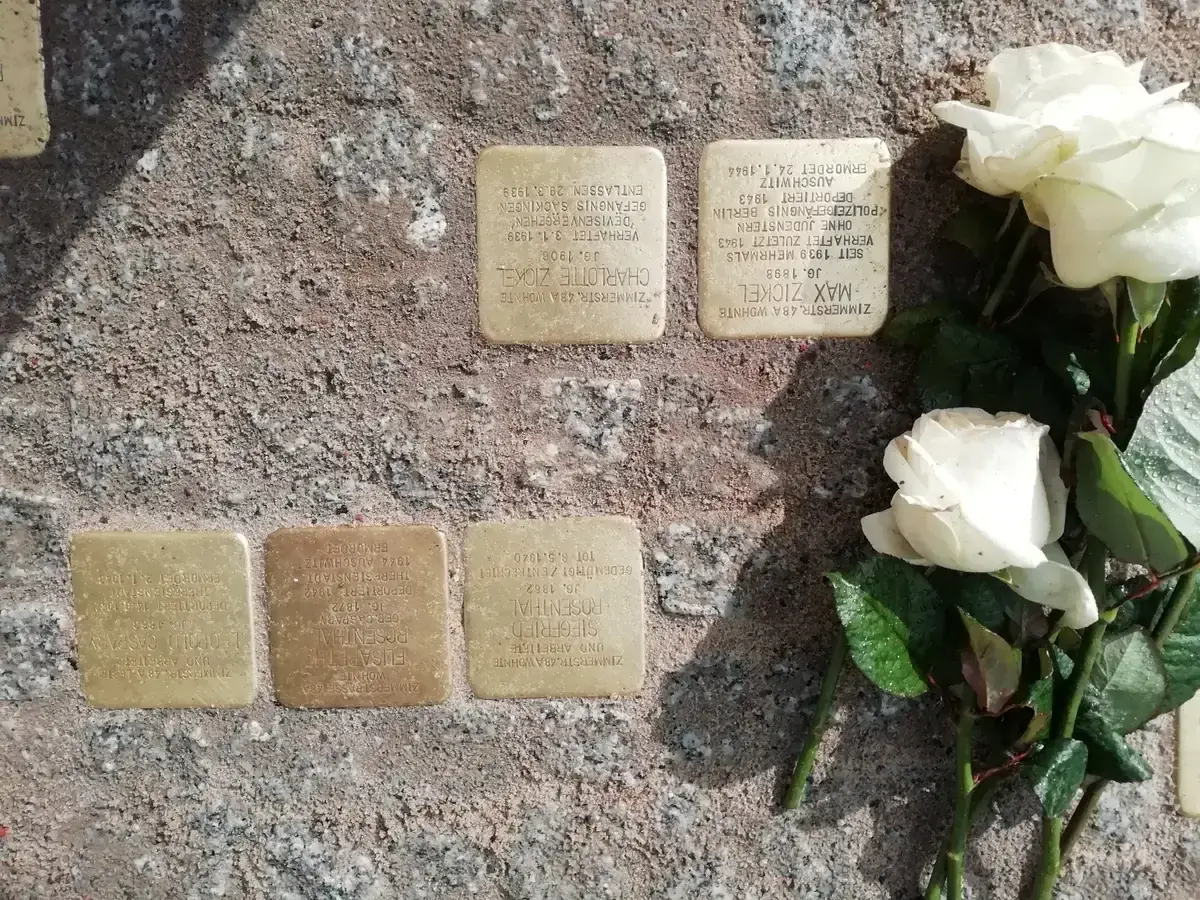
A group of Stolpersteine on Zimmerstrasse in Berlin-Mitte, with white roses laid beside them. Photo: Berihert, CC BY-SA 3.0, via Wikimedia Commons
Where Stolpersteine Fit Among Berlin's Memorials
Berlin remembers the victims of National Socialism at several scales, from national memorials in the government quarter to a 10 cm brass cube outside a former apartment. Each form does a different job, and the contrast is worth understanding before you plan a route.
Memorials That Name Victims as Groups
The central memorials commemorate categories of victims rather than individuals. The Memorial to the Murdered Jews of Europe, covered in full on the Holocaust memorial Berlin page, holds about 2,700 concrete stelae on a field of 19,073 square metres. Its underground Information Centre keeps the names of about 3 million Jewish victims supplied by Yad Vashem. Admission is free and the field is open around the clock.
Two memorials for other victim groups stand nearby in the Tiergarten. The memorial to the Sinti and Roma victims of National Socialism opened on 24 October 2012 on Simsonweg. Dani Karavan designed it as a dark circular pool with a single triangular stone and a fresh flower placed daily. Estimates of the Porajmos victims range from 220,000 to 500,000. The memorial to homosexuals persecuted under Nazism was inaugurated on 27 May 2008, a concrete block by Michael Elmgreen and Ingar Dragset with a window showing a looped film.
A Stolperstein works differently. It does not represent a group, a number or a design concept. It names one person, with dates of birth, deportation and death, set into the pavement in front of the last address that person freely chose. The abstract scale of the stelae field and the biographical scale of the stone belong together, which is why many visitors see both on the same day.
Anhalter Bahnhof and Deportation History
Southwest of Potsdamer Platz, the surviving façade of Anhalter Bahnhof marks a site where group fate becomes individual loss. From this station, 9,600 Jews were deported to Theresienstadt in 116 transports. The station opened in 1841 and sits about 600 m southeast of Potsdamer Platz. Long-distance traffic ended on 17 May 1952, and the ruin was demolished in 1960, leaving the section of façade you see today.
The station also connects directly to the Stolpersteine story. The neighbouring Friedrichshain-Kreuzberg district has about 1,100 stones laid, more than any other district named in the official figures. More than 11,000 Stolpersteine lie across Berlin in total. Walking from a deportation platform past apartment blocks with stones in front of them makes the sequence concrete, from home to collection point to transport.
Nearby, the Berlin Story Bunker at Schöneberger Straße 23A occupies a 1942-43 air-raid shelter built for rail passengers at Anhalter Bahnhof. Its exhibition 'Hitler - How could it happen' spans three floors. If you want a guided frame for the government quarter as well, the historian-led walk Hitler's Berlin covers nine sites including the Holocaust Memorial and the Topography of Terror in 2.5 hours for $51 with at most 10 guests.
A Walking Plan That Pairs Stones With the Memorial
A practical pairing starts in Kreuzberg, where about 1,100 of Berlin's stones lie. Pick a street, look down, read the plates, and note the addresses. The Koordinierungsstelle Stolpersteine Berlin, the city's coordination office at Stauffenbergstraße 13-14, maintains the map and database of stone locations, which is the reliable way to plan which streets to walk.
From there, take the S-Bahn or U-Bahn toward Brandenburg Gate. Walking route measurements from the Holocaust Memorial place the Brandenburg Gate about 348 m away, roughly 5 minutes on foot. The field of stelae is free and open 24 hours, and the Information Centre below it opens Tuesday to Sunday 10:00-18:00 with last admission 45 minutes before closing.
The route contrasts two registers of memory. The stones record where people lived, the memorial records the scale of their murder. If you want the government quarter sites connected by a guide, the historian-led walk covers the Memorial to the Sinti and Roma Victims, the Holocaust Memorial and Hitler's bunker site in one route, and its meeting point at Pariser Platz sits a few minutes from both memorials. Note that no tour includes Stolpersteine locations as a stated destination, so plan the stone hunt yourself using the coordination office's map.
Frequently Asked Questions
How many Stolpersteine are there?
By June 2023 more than 100,000 Stolpersteine had been laid, and the 100,000th stone was placed in Nuremberg on 26 May 2023. More than 11,000 of them lie in Berlin. You can plan a walk past some of them with the help of this guide.
Why are they called Stolpersteine?
The German word means 'stumbling stone'. The project was started by the artist Gunter Demnig, who laid the first stone in Cologne on 16 December 1992.
When did Stolpersteine first appear in Berlin?
The first stones in Berlin were 55 laid in Kreuzberg in 1996, four years after the very first stone in Cologne. The district now holds about 1,100 of them. For the wider history, see the 2-hour Third Reich and Cold War walking tour, which starts at the Brandenburg Gate.
Who makes Stolpersteine and what do they cost?
The stones are concrete cubes of 10 cm with a brass plate, and about 440 can be produced per month. A stone cost €120 as of 2012. The project was started by the artist Gunter Demnig.
Where in Berlin can I get information about a particular Stolperstein?
The Koordinierungsstelle Stolpersteine Berlin at Stauffenbergstraße 13-14 is the city's coordination office for the project. The same building houses the German Resistance Memorial Center, which is free and open daily, Monday to Friday from 9:00 and weekends and holidays from 10:00, closing at 18:00. The guide to the German Resistance Memorial Center has the details.
Is there a guided tour that covers the history behind the stones?
Yes. The historian-led walk costs $51, lasts 2.5 hours and covers nine Third Reich sites including Hitler's Bunker site and the Topography of Terror with a maximum of 10 guests. It is an outdoor walk, so it does not include museum entry or transport. You can compare it with other Berlin WW2 tours on the homepage.