 Berlin WW2 Tours
Olympic Stadium Berlin 1936: What You See Today
The Olympic Stadium Berlin 1936 is the stadium built for the Summer Games held under the Nazi dictatorship. It still stands in the west of the city, and you can walk it on your own or on a guided tour. This page covers the history of the 1936 Olympics at this site, the Maifeld, the Bell Tower, and what a visit involves today. It also explains the event-day closures that catch visitors out, and how to reach the stadium by S-Bahn or U2. The stadium sits far from the central sites of the Nazi government quarter, so none of the Berlin WW2 tours compared here includes it. This page helps you plan a do-it-yourself visit instead, or add the stadium to a longer Berlin WW2 itinerary.
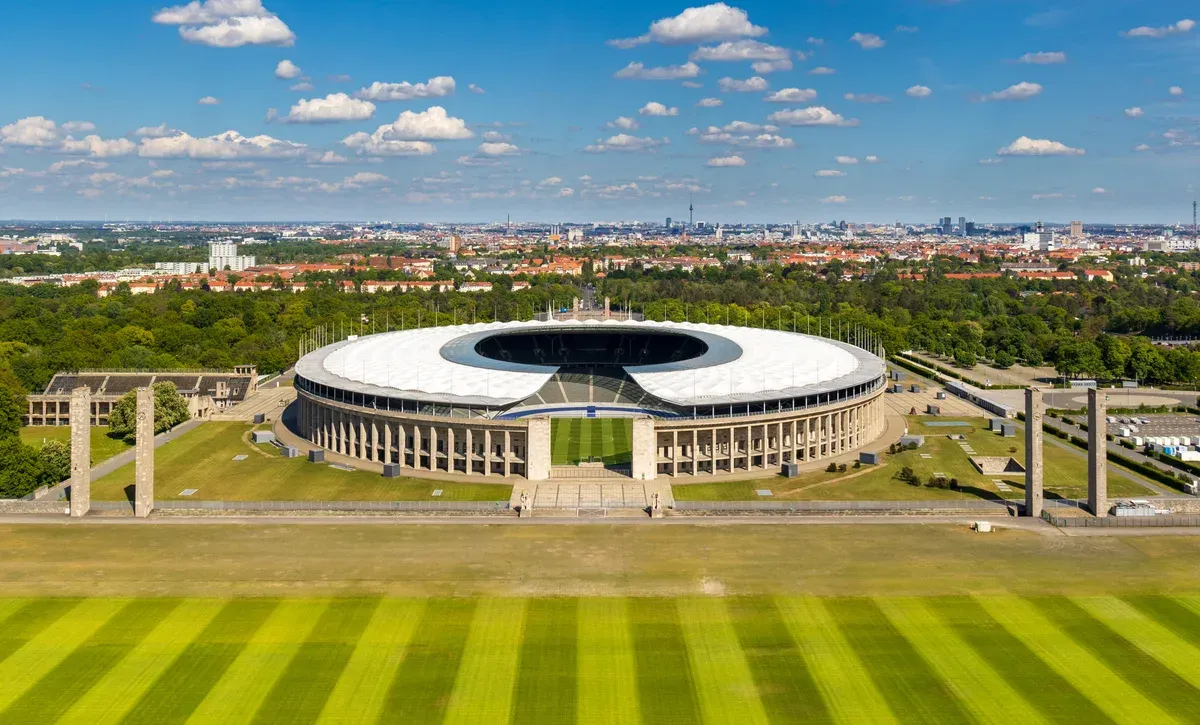
The Olympiastadion from the Olympic Gate side with the Maifeld in front. Photo: Matthias Süßen, CC BY-SA 4.0, via Wikimedia Commons
Quick answer Olympic Stadium Berlin 1936 at a glance
The Olympic Stadium built for the 1936 Berlin Games still stands and is open to visitors, and visits are booked through the stadium's own ticket shop. The Nazi regime staged the Games here, and Jesse Owens won four gold medals in the stadium. You reach it by S-Bahn Olympiastadion or the U2 line.
Key takeaways
- Book your stadium ticket in advance at the official shop, because the stadium closes on match and event days, see Visiting the Stadium Today.
- The Bell Tower stands at the Maifeld on the same grounds, see The Bell Tower and the Maifeld.
- The stadium sits far west of the government quarter, so plan it as its own half day alongside the Berlin WW2 tours in the centre.
- For a guided walk past the central Nazi sites instead, see the comparison of Third Reich walking tours.
The 1936 Olympic Games Stadium
The Olympiastadion was built for the Games that the Nazi regime opened on 1 August 1936. It still stands today.
Built for the Games
The architects were Werner and Walter March. Construction took 28 months. Sources disagree on the original capacity: English-language sources give 110,000 places and German-language sources give 100,000, so treat either figure as approximate. The complex was more than the bowl. It included the Maifeld, which measures 11.2 hectares, and a 77 m Bell Tower. The Nazi regime opened the Games here on 1 August 1936.
Jesse Owens won four gold medals in this stadium in 1936.
War, Demolition and Rebuild
The Bell Tower was damaged in WWII and the British demolished it in 1947. The tower was rebuilt in 1960 to 1962 and stands again at 77 m. The Olympic bell inside it weighs about 9.6 tonnes. The stadium has hosted the DFB-Pokal final since 1985.
The largest change came in the renovation of 2000 to 2004, which cost €242 million. The playing field was lowered by 2.65 m and a new roof covering 37,000 square metres was added, so the modern bowl reads differently from the 1936 building. Current capacity is also reported with two figures, 74,475 in English sources and 73,856 in German ones. About 300,000 tourists visit the stadium each year, alongside the match and event crowds.
Key Dates for the Site
The table lists the dates for the stadium and tower that the sources give.
| Date | Event |
|---|---|
| 1 August 1936 | The Olympic Games are opened in the stadium |
| 1936 | Jesse Owens wins four gold medals in the stadium |
| 1947 | The war-damaged Bell Tower is demolished by the British |
| 1960-1962 | The Bell Tower is rebuilt at 77 m |
| 1985 | The stadium begins hosting the DFB-Pokal final |
| 2000-2004 | Renovation costing €242 million lowers the field by 2.65 m and adds a 37,000 square metre roof |
Visiting the Stadium Today
You can visit the stadium on your own with a ticket or join a guided tour. Both are booked through the stadium's own ticket shop.
Tickets and Tour Prices
Tickets are booked at tickets.olympiastadion.berlin. Both a self-guided visit and a 60-minute guided tour are offered. The official stadium page did not show visitor prices when it was checked, so confirm the current prices on the official shop before you book. The Bell Tower is not part of the basic self-guided ticket. It is offered as a separate bookable tour or as part of a premium tour, and a price for the tower alone is not stated in the sources used here.
For context, this stadium visit is ticketed, unlike the central memorial sites. The Topography of Terror and the Memorial to the Murdered Jews of Europe are both free, which is why many visitors spend their budget on World War II tours in Berlin in the centre and add the stadium only if the west of the city fits their plan.
Event-day Closures and Opening Hours
The stadium is closed to visitors on match and event days. The closures matter because the stadium is an active football ground that hosts the DFB-Pokal final. Check the event calendar before you travel and book a dated ticket slot on the official shop.
Daily and weekly opening hours vary with the event schedule and are not given as a single fixed pattern in the sources used here, so rely on the shop for the day you plan.
The Bell Tower and the Maifeld
The 77 m Bell Tower at the Maifeld holds the Olympic bell, which weighs about 9.6 tonnes. Access is only through the bookable tower tour or a premium tour, so add it when you buy your ticket if you want to go up. The original tower stood until the 1947 demolition and the present one dates from the 1960 to 1962 rebuild.
Getting There
The stadium is served by the S-Bahn station Olympiastadion and by the U2 underground line, which also stops at Olympiastadion. The U2 is the simpler option if you start near a U2 station. A single AB ticket costs €4 reduced €2.50 and is valid 2 hours, and a 24-hour AB ticket costs €11.20 reduced €7.40.
Tickets are sold at machines and via the BVG app.
The History and Present of the Olympic Stadium Berlin
The stadium's own film on its history since 1936. Third-party video by Olympiastadion Berlin. This site did not shoot it and has no relationship with the creator.
Combining It with the Kaiser Wilhelm Memorial Church
Both sites lie in the west of Berlin, and no guided WW2 walking tour reaches either of them, so this is a half day you arrange yourself.
A Do-it-yourself Half Day in the West
The Kaiser Wilhelm Memorial Church on Breitscheidplatz preserves the ruined spire of a church bombed on 22 November 1943. The remaining spire stands at about 71 m, with Egon Eiermann's new church completed in 1959 to 1963 beside it. The church is open daily 10:00 to 18:00 and admission is free, and the Breitscheidplatz stop is served by S3, S5, S7, S9, U1, U2, U9 and buses 100, 200 and M46 within about 100 m.
The practical link is the U2. The line serves both Breitscheidplatz area stations and Olympiastadion, so you can ride from the church to the stadium without changing trains. Plan the stadium for a booked morning or midday slot, then return east to the church for the afternoon. A distance figure for the ride is not stated in the sources used here, but the two stops sit on the same line. If you would rather see the central Third Reich sites with a guide, the Berlin Third Reich and Cold War 2-Hour Guided Walking Tour covers the government quarter for $27, and the Hitler's Berlin: Historian-Led Third Reich and WWII Walking Tour runs with at most 10 guests for $51.
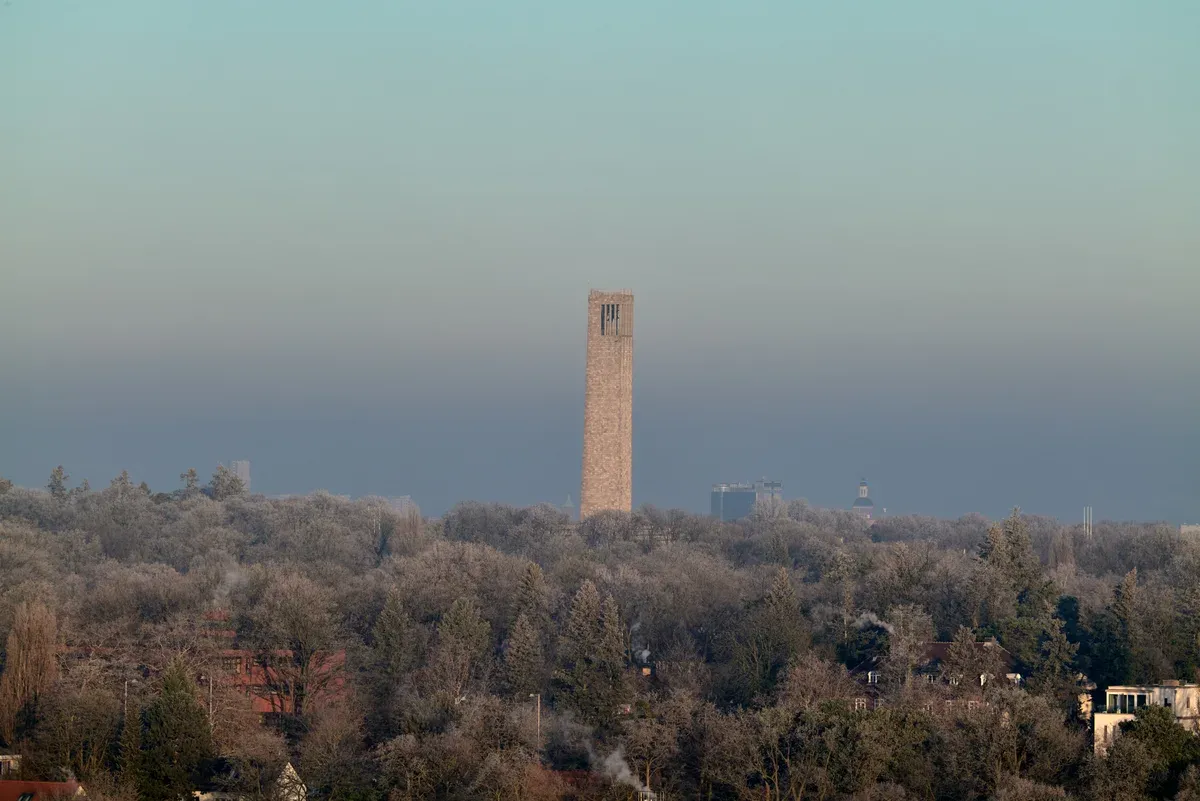
The Glockenturm rising above the trees of the Olympic grounds, seen from Drachenberg. Photo: Leonhard Lenz, CC0, via Wikimedia Commons
Berlin's Other Nazi-Era Buildings
The Olympic Stadium was not the only large building the Nazi state left behind. Three other structures still stand, and each tells a different part of the story.
Tempelhof Airport Building
The old Tempelhof airport terminal has about 300,000 square metres of floor space. Built as a showcase of the regime, it later served the Berlin Airlift. Today you can see it only on a guided tour. Tours start at the CHECK-IN visitor centre, Platz der Luftbrücke 5, 12101 Berlin. A 2-hour German-language aviation tour is quoted from €17.50, and a secondary listing quotes English tours Thursday to Sunday at 13:30, 2 hours, at €16.50 adult, €11 students and €8 for children 6 to 14. Official English tours called 'Tempelhof Myths', 'Hidden Places' and 'THF in 60 minutes' are booked through Museumsdienst Berlin. The tours are not suitable for wheelchair users.
For more on Third Reich sites you can visit with a guide, see the comparison of Berlin WW2 tours.
The Former Air Ministry on Wilhelmstraße
The Detlev-Rohwedder-Haus on Wilhelmstraße was built as the Reich Aviation Ministry, Hermann Göring's ministry. It is one of the few central government buildings of the era that survived the 1944-45 bombing largely intact. Today it houses the Federal Finance Ministry, so you view it from the street rather than inside.
The building sits near the Topography of Terror documentation centre at Niederkirchnerstraße 8, where admission is free and the centre is open daily 10:00 to 20:00. The 2-hour walk from the Brandenburg Gate to Checkpoint Charlie covers the government quarter around it, and the Hitler and WWII 3-hour walking tour names Goering's former Air Ministry among its stops.
The Schwerbelastungskörper in Tempelhof
The Heavy Load-Bearing Body stands at Dudenstraße, General-Pape-Straße and Loewenhardtdamm in Tempelhof. It was built in 1941-1942 to test whether Berlin's sandy soil could carry the planned triumphal arch of the 'Germania' redesign of the city. The concrete cylinder is 14 m tall, 21 m across and weighs about 12,650 tonnes. After about 2.5 years it had sunk 19 cm, far beyond the 6 cm considered acceptable, which showed the arch was not buildable on this ground. The structure has been a protected monument since 1995.
A comparison of the three sites:
| Building | What it was | Key figure | Access today |
|---|---|---|---|
| Tempelhof terminal | Airport built under the regime | about 300,000 sq m floor space | guided tours only |
| Detlev-Rohwedder-Haus | Reich Aviation Ministry | survived 1944-45 bombing | exterior, government offices |
| Schwerbelastungskörper | Soil test for the Germania arch | 12,650 tonnes, sank 19 cm | protected monument since 1995 |
Sources: Olympiastadion Berlin, Olympiastadion, Wikipedia), Tempelhof guided tours, Schwerbelastungskörper
Frequently Asked Questions
Does the 1936 Berlin Olympic Stadium still exist?
Yes. The stadium built for the Games opened on 1 August 1936 still stands and is an active football ground and has hosted the DFB-Pokal final since 1985. The 2000 to 2004 renovation lowered the field by 2.65 m and added a 37,000 square metre roof, so parts of what you see are modern. See the history section for the full timeline.
Can you visit the Olympic Stadium without a guided tour?
Yes. A self-guided visit is possible. The official page showed no visitor prices when checked, so confirm on tickets.olympiastadion.berlin. A 60-minute guided tour is also offered. The stadium closes on match and event days.
How do you get to the Olympiastadion by public transport?
The stadium is served by the S-Bahn station Olympiastadion and by the U2 line, which stops at Olympiastadion. A single AB ticket costs €4 and a 24-hour AB ticket €11.20. The U2 also connects the stadium with the Kaiser Wilhelm Memorial Church area in the west.
What did Hitler do about Jesse Owens at the 1936 Olympics?
Jesse Owens won four gold medals in the stadium in 1936. The sources used for this page record his four golds but give no account of the leadership's personal response, so this page does not repeat the common stories. His wins remain the central sporting memory of the 1936 Games.
What is the Bell Tower and can you go up it?
The 77 m Bell Tower stands at the 11.2 hectare Maifeld and holds the Olympic bell, which weighs about 9.6 tonnes. It was demolished in 1947 after war damage and rebuilt in 1960 to 1962. Access is through a separate bookable tower tour or a premium tour, added when you book your stadium ticket.
How much time should I plan and what else is nearby?
A duration for the visit is not stated in the sources used here, so allow time for the grounds and any tour you book. Pair it with the Kaiser Wilhelm Memorial Church on the U2, which is free and open daily 10:00 to 18:00. Both sites lie outside the central walking-tour area, so treat them as their own outing.