 Berlin WW2 Tours
Holocaust Memorial Berlin: Visiting the Memorial to the Murdered Jews of Europe
The Holocaust memorial Berlin knows best stands about 348 m on foot from the Brandenburg Gate. Peter Eisenman's field of about 2,700 concrete stelae covers 19,073 square metres and is open around the clock. Below the field, the Information Centre keeps the names of about 3 million Jewish victims. This guide explains what the memorial is, how the two parts differ, when each is open and how to visit with respect. It also covers the three further memorials to Nazi victims that the same foundation maintains. If you would rather see the memorial in context, Berlin WW2 tours include it on several guided walks described on this site.
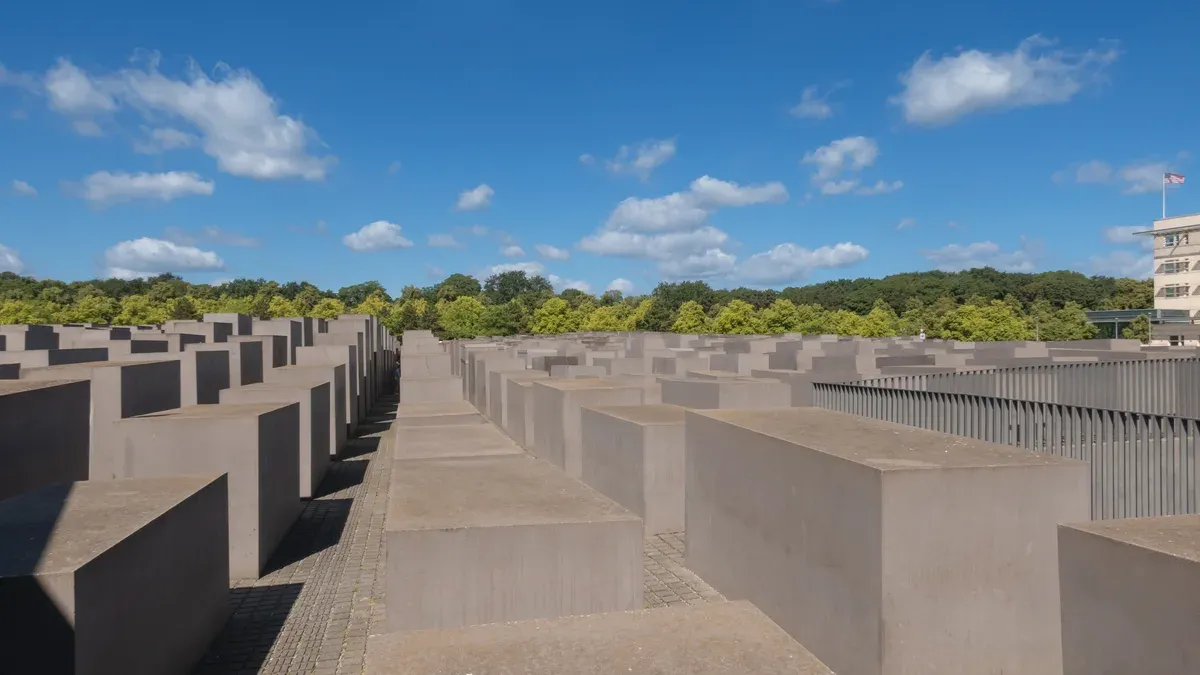
The Memorial to the Murdered Jews of Europe seen from Cora-Berliner-Strasse. Photo: Michielverbeek, CC BY 4.0, via Wikimedia Commons
Quick answer The short answer
The Holocaust memorial Berlin is the Memorial to the Murdered Jews of Europe at Cora-Berliner-Straße 1, a field of about 2,700 concrete stelae by Peter Eisenman on 19,073 square metres, open 24 hours a day with free admission. Below it, the Information Centre is open Tuesday to Sunday 10:00 to 18:00, closed Mondays, also free.
Key takeaways
- The field of stelae never closes, but the underground Information Centre shuts on Mondays and admits the last visitors 45 minutes before closing.
- The Information Centre holds the names of about 3 million Jewish victims from Yad Vashem in its Room of Names.
- The same foundation maintains three further memorials to Nazi victims: to homosexuals persecuted under Nazism, to the Sinti and Roma, and to the T4 victims.
- The historian-led walk to nine Third Reich sites stops at the memorial and at the Sinti and Roma Memorial, and the comparison of Berlin WW2 tours shows every option side by side.
Visiting the Memorial and the Information Centre
The memorial has two parts with different rules. The open field is always accessible. The underground Information Centre keeps museum hours and screens every visitor at security.
Practical Details at a Glance
Everything below comes from the memorial foundation and the memorial's own published details. Admission to both the field and the Information Centre is free. An audio guide costs €3, or €2 for school groups.
Free public tours run in English on the first Sunday of the month at 14:00 and in German on the third Sunday at 14:00, and group tours can be booked in more than 10 languages.
| Item | Detail |
|---|---|
| Address | Cora-Berliner-Straße 1, 10117 Berlin |
| Field of stelae hours | Accessible 24 hours a day |
| Information Centre hours | Tuesday to Sunday 10:00 to 18:00, last admission 45 minutes before closing |
| Closed days | Mondays (with listed exceptions), 24 to 26 December, and from 16:00 on 31 December, opens at noon on 1 January |
| Admission | Free, audio guide €3 (€2 for school groups) |
| Nearest stations | S+U Brandenburger Tor and the Ebertstraße stop |
| From the Brandenburg Gate | About 348 m, roughly a 5 minute walk |
| Free tours | English on the first Sunday at 14:00, German on the third Sunday at 14:00 |
| Accessibility | 13 wheelchair-accessible corridors through the field |
How to Behave on the Site
The house rules are explicit. Noise, jumping between the stelae, pets, smoking and commercial photography without written consent are all banned. All visitors to the Information Centre pass through security screening, so allow for the screening.
The field is a place of mourning first and a sight second. About 3.5 million people visited in the first year, and roughly 350,000 visited the Information Centre in 2005.
The Field of Stelae
The field is the part most visitors mean when they say Holocaust memorial. It is a field of concrete stelae by Peter Eisenman.
Design and Size
Peter Eisenman designed the memorial with the engineering firm Buro Happold, after the Bundestag approved his entry on 25 June 1999 by 314 votes to 209. His design had won a competition that drew 528 entries. The field holds about 2,700 concrete stelae, laid out in 54 rows by 87 columns on 19,073 square metres, roughly 1.9 hectares.
Each stele measures 2.38 m by 0.95 m. Sources give the heights as ranging from 0.2 m up to 4.7 m. Construction ran from 1 April 2003 to 15 December 2004 at an official cost of €27.6 million.
Dates and Meaning
The memorial was inaugurated on 10 May 2005 and opened to the public two days later. It commemorates the Jewish victims of the Nazi genocide. By 2007 about 400 stelae had developed hairline cracks and were reinforced with steel collars, and the anti-graffiti coating supplied by Degussa drew criticism because a Degussa subsidiary had made Zyklon B. The site has carried argument from the start, and that argument is part of its history.
Memorial to the Murdered Jews of Europe
Rick Steves at the field of stelae beside the Brandenburg Gate. Third-party video by Rick Steves' Europe. This site did not shoot it and has no relationship with the creator.
Inside the Information Centre
The Information Centre is where the memorial finds its voice. It has about 800 square metres of exhibition space.
Four Rooms
The Centre has four rooms. The Room of Families presents 15 families. The Room of Names holds the names of about 3 million Jewish victims, supplied by Yad Vashem.
Entry is free and the exhibition is open Tuesday to Sunday 10:00 to 18:00, with the last admission 45 minutes before closing.
Planning Your Visit Below Ground
Free public tours in English run on the first Sunday of the month at 14:00 and in German on the third Sunday at 14:00, which helps if you prefer a structured route through the rooms. Audio guides cost €3, or €2 for school groups. Remember the Centre closes on Mondays and on 24 to 26 December, closes from 16:00 on 31 December and opens at noon on 1 January, while the field above stays open in every case.
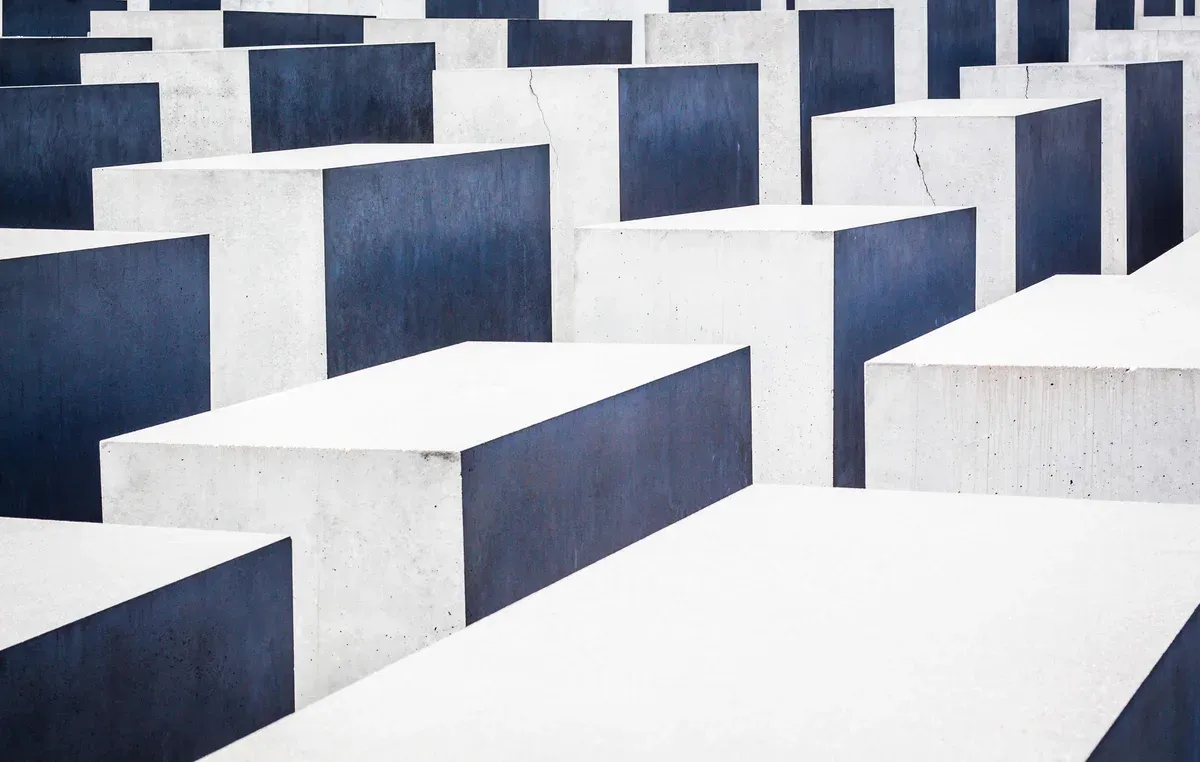
Concrete stelae of the Memorial to the Murdered Jews of Europe. Photo: Ferdinand Stöhr fellowferdi, CC0, via Wikimedia Commons
The Other Memorials Nearby
The same foundation maintains memorials to other groups persecuted by the Nazis, .
Memorial to the Homosexuals Persecuted Under Nazism
Michael Elmgreen and Ingar Dragset designed this memorial as a concrete cube, 3.60 m tall and 1.90 m wide, with a single window through which a film of a kiss plays on a loop. The Bundestag authorised it on 12 December 2003 and it was inaugurated on 27 May 2008. The original film was replaced on 26 January 2012 by 'Kuss ohne Ende'.
Memorial to the Sinti and Roma Victims of National Socialism
Dani Karavan designed this memorial on Simsonweg as a dark circular pool with a triangular stone at its centre, where a fresh flower is placed every day. It opened on 24 October 2012 and cost €2.8 million. The poem 'Auschwitz' by Santino Spinelli appears in four languages.
Estimates of the number of Sinti and Roma murdered by the Nazis range from 220,000 to 500,000, and the memorial keeps the scale of that loss in view without reducing it to one figure.
Memorial to the Victims of the Nazi 'Euthanasia' Killings
This memorial opened on 2 September 2014 at Tiergartenstraße 4. Ursula Wilms, Heinz W. Hallmann and the artist Nikolaus Koliusis won the 2012 competition for it, and the result is a 30 m light-blue glass wall. The T4 central office coordinated the murders of nearly 200,000 people.
The historian-led walk through nine Third Reich sites, priced at $51 for 2.5 hours with at most 10 guests, names the Sinti and Roma Memorial in its route, alongside a broader comparison of WW2 tours in Berlin.
Combining the Memorial with Nearby Sites
The Memorial to the Murdered Jews of Europe sits at the centre of a cluster of Third Reich sites that you can cover on foot in a single day.
Walking Distances to the Main Sites
The memorial stands about 451 m from the Führerbunker site, a walk of about 6 minutes, and about 1,225 m from the Topography of Terror, about 16 minutes. The Brandenburg Gate is about 348 m away, roughly 4.6 minutes, and Potsdamer Platz about 654 m, about 8.7 minutes. The Führerbunker site to Topography of Terror leg is about 843 m, around 11 minutes. The figures come from OpenStreetMap foot routing and are approximate.
A sensible order is the Brandenburg Gate first, then the memorial, then the bunker site and the Topography of Terror. All four stops together form the core of most Third Reich walking routes in the city, and you can compare them on the homepage overview of Berlin WW2 tours.
| Route | Distance | Approx. time on foot |
|---|---|---|
| Brandenburg Gate to Holocaust Memorial | about 348 m | about 4.6 minutes |
| Holocaust Memorial to Führerbunker site | about 451 m | about 6.0 minutes |
| Führerbunker site to Topography of Terror | about 843 m | about 11.2 minutes |
| Holocaust Memorial to Topography of Terror | about 1,225 m | about 16.3 minutes |
| Brandenburg Gate to Topography of Terror | about 1,462 m | about 19.5 minutes |
What Each Site Adds
The Führerbunker site is a car park at Gertrud-Kolmar-Straße with a single bilingual information board installed in 2006. The bunker itself lay about 8.5 m below the Chancellery garden and nothing of it is visible today. The stop documents where the dictatorship ended, with Hitler's suicide on 30 April 1945.
The Topography of Terror at Niederkirchnerstraße 8 documents how the regime worked. The Gestapo headquarters, the SS leadership and the Reich Security Main Office stood on this block from 1933 to 1945. Admission is free and the centre is open daily 10:00 to 20:00, with a 15-station outdoor tour of the grounds. A 200 m section of the Berlin Wall stands beside the site.
Closer to the memorial, the free historian-led Hitler's Berlin: Historian-Led Third Reich and WWII Walking Tour covers $51 for 2.5 hours and includes the memorial, the bunker site and the Topography of Terror in one route.
| Site | Theme | Admission |
|---|---|---|
| Führerbunker site | Where Hitler spent his final days, 8.5 m underground | Free, information board only |
| Topography of Terror | Gestapo, SS and Reich Security Main Office | Free |
| Bebelplatz and the Empty Library | Book burning of 10 May 1933 | Free to view |
Bebelplatz, Anhalter Bahnhof and Guided Walks
Bebelplatz, north of the memorial near Unter den Linden, marks the Nazi book burning of 10 May 1933, when about 20,000 books were burned. Micha Ullman's Empty Library, a glass plate set in the cobbles over empty shelving for 20,000 volumes, remembers them. A plaque quotes Heinrich Heine: where they burn books, they will in the end also burn people.
Southwest of Potsdamer Platz stands the ruin of Anhalter Bahnhof, about 600 m from Potsdamer Platz. From here, 9,600 Jews were deported to Theresienstadt in 116 trains. The station's deportation history connects directly with the memorial's subject.
If you prefer company, the 2-hour walk costs $27 and starts at the Brandenburg Gate, passing the memorial, the bunker site and the Topography of Terror with a guide. It is the most reviewed WW2 walk in the site's Berlin WW2 tours comparison.
Questions About the Holocaust Memorial
Is the Holocaust memorial in Berlin free?
Yes. Entry to both the field of stelae and the underground Information Centre is free, and free public tours run in English on the first Sunday of the month at 14:00. The only charges are the €3 audio guide, or €2 for school groups, and the guided options listed in the WW2 tours in Berlin comparison.
What are the opening hours of the Memorial to the Murdered Jews of Europe?
The field is accessible 24 hours a day. The Information Centre is open Tuesday to Sunday 10:00 to 18:00, with the last admission 45 minutes before closing, and it is closed on Mondays as detailed in this guide's visiting section.
What is the significance of the Holocaust memorial in Berlin?
It is the Memorial to the Murdered Jews of Europe, inaugurated on 10 May 2005 after a Bundestag decision approved Eisenman's design by 314 votes to 209. Its Information Centre holds the names of about 3 million victims from Yad Vashem, as described in Inside the Information Centre.
How long should I plan for a visit?
The sources give no visit time. If you want the memorial explained in context, the historian-led Third Reich walk covers it in 2.5 hours together with eight further sites.
Do I need tickets or a time slot for the Information Centre?
No. Entry is free, but every visitor to the Information Centre passes through security screening. The practical details, including the Monday closure, are set out in the practical details table.
What else is close to the memorial?
The Führerbunker site lies about 451 m away, roughly a 6 minute walk, and is covered in the separate Hitler's bunker guide. The memorial to the Sinti and Roma is on Simsonweg in the Tiergarten and the T4 memorial is at Tiergartenstraße 4, as described in The Other Memorials Nearby.