 Berlin WW2 Tours
Flak Towers in Berlin
The flak towers in Berlin were a set of six huge concrete structures, three pairs of a gun tower and a control tower, built on Hitler's order after RAF bombers first reached the city. This guide covers where each pair stood, what the towers were for, what happened to them after 1945 and what you can still see. Only one ruin, in Volkspark Humboldthain, can be entered today, on a Berliner Unterwelten tour. For the wider picture, see the comparison of Berlin WW2 tours.
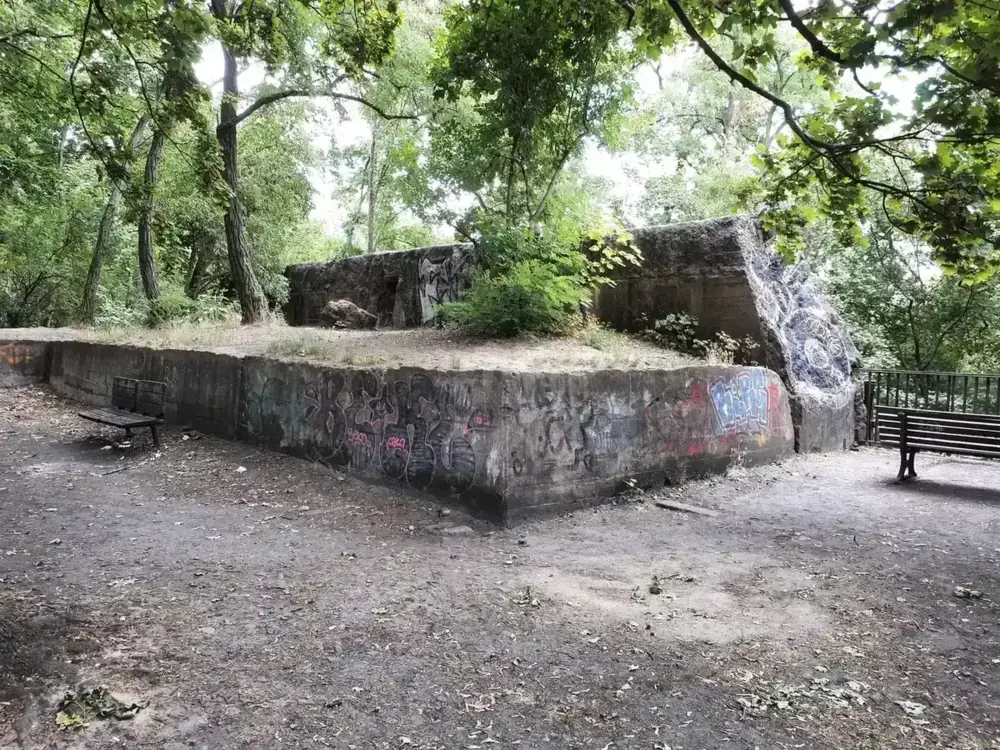
Ruined concrete remains of the Humboldthain flak tower among the trees of the park. Photo: Fridolin freudenfett, CC BY-SA 4.0, via Wikimedia Commons
Quick answer The essentials
Berlin had six flak towers, three pairs of a gun tower and a control tower, at the Zoo, in Friedrichshain and in Humboldthain. The first pair was finished in April 1941. Only the Humboldthain ruin can be entered today, on the flak tower tour, which costs €17 (reduced €13) and lasts 90 minutes per the 2025 flyer.
Key takeaways
- Enter the only accessible ruin on Berliner Unterwelten's flak tower tour, restricted to age 18 and over.
- The outside of the Humboldthain bunker is free to see from the park, and the Wall and Third Reich bike tour names it among its stops.
- Compare every guided option on the Berlin WW2 tours homepage, from walking tours to the bike tour.
- Plan the flak tower visit alongside the other sites in the Berlin WW2 itinerary.
Berlin's Three Flak Tower Pairs
Hitler ordered the Berlin flak towers on 9 September 1940, after RAF bombers first raided the city on the night of 25-26 August 1940 with 22 aircraft. Berlin ended up with six large flak tower structures, three pairs of a gun tower and a control tower.
The Pairs at a Glance
The table compares the three Berlin flak tower pairs: when each was built, what happened to it after 1945 and what a visitor sees at the site today. The figures come from the historical sources listed below. Each pair consisted of a G-tower (gun tower) and an L-tower (control tower) working together, and the fates of the three pairs differ sharply.
The Zoo pair was blown up completely, the Friedrichshain pair was buried under rubble mounds, and the Humboldthain pair was only partly demolished, which is why its northern section survives as a walkable ruin.
| Pair | Built | Fate after 1945 | What you see today |
|---|---|---|---|
| Zoo (Gustav) and Tiergarten control tower | 1939-1941, gun tower finished April 1941 | Control tower blown up 28 July 1947 with 12 tonnes of dynamite. Gun tower destroyed 30 July 1948 with 40 tonnes of TNT | Nothing. About 412,000 cubic metres of rubble were removed and camel and rhino enclosures were later built on the site |
| Friedrichshain | Finished October 1941 | Blown up by the Red Army in May 1946, with only partial success | Two rubble mounds, the Großer and Kleiner Bunkerberg, in Volkspark Friedrichshain. An observation platform stands on the Großer Bunkerberg |
| Humboldthain | October 1941 to April 1942, built with many forced labourers | Demolition stopped early because the Ringbahn line beside it could not be damaged | The northern section stays visible and can be entered on a Berliner Unterwelten tour |
The Zoo Pair
The Zoo gun tower, named Gustav, was finished in April 1941. The control tower was built in 1939-1941 across the Landwehrkanal in the Tiergarten. During an alarm the Zoo tower sheltered up to 16,000 civilians, and the headquarters of the 1st Flak Division under Generalmajor Otto Sydow sat inside the Zoo bunker.
Hermann Göring stayed briefly in the Zoo bunker hospital in April 1945. The bunker also stored Schliemann's 8,900-piece Priam's Treasure, which a Soviet trophy commission seized in May 1945. Moscow's Pushkin Museum revealed only in 1994 that it held the treasure.
Both towers fell in the British sector. The control tower was blown up on 28 July 1947 with 12 tonnes of dynamite, and the gun tower was finally destroyed on 30 July 1948 with 40 tonnes of TNT. Sources differ on whether the gun tower fell in 1947 or 1948.
Sources differ on whether the gun tower fell in 1947 or 1948. Nothing stands today.
The Friedrichshain Pair
The Friedrichshain towers were finished in October 1941. Over 700 square metres of Berlin Picture Gallery paintings were stored in the smaller control tower, and about 434 of those paintings burned there, probably on 6 May 1945, in circumstances never explained. The Red Army blew the towers up in May 1946 with only partial success, so the remains were turned into hills.
Two rubble mounds, the Großer and Kleiner Bunkerberg, now shape Volkspark Friedrichshain. The Friedrichshain mound carries the nickname Mont Klamott. An observation platform stands on the remains of the combat tower atop the Großer Bunkerberg, which lets you stand on flak tower concrete.
The Humboldthain Pair
The Humboldthain tower was built from October 1941 to April 1942 using many forced labourers. After the war the demolition teams could not destroy it fully, because the Ringbahn railway line beside the park could not be damaged. That accident of geography is the reason Berlin has a flak tower ruin at all.
The northern section of the bunker stays visible above the park and can be entered on a Berliner Unterwelten tour, the only way inside. The park is reached from S+U Gesundbrunnen station, which also has the association's shelter under the station used on its other bunker tour.
Sources: Flak tower history and flak tower specifications
What a Flak Tower Did
Each pair combined a gun tower and a control tower. The structures served three purposes at once: anti-aircraft defence, civilian shelter and art storage.
The G-Tower and the L-Tower
Every pair consisted of a G-tower, the gun tower that carried the anti-aircraft batteries, and an L-tower, the control tower that aimed them. A first-generation G-tower measured 70.5 metres square and about 39 metres tall, with concrete walls up to 3.5 metres thick. A first-generation G-tower mounted eight 128 mm FlaK 40 guns.
Speed of construction was extraordinary: all three Berlin gun towers went up within six months, and national rail schedules were altered to deliver materials. As concrete shelters and vaults they protected people and stored property.
Shelter and Storage
The Zoo tower sheltered up to 16,000 civilians during an alarm, a figure that shows the scale of the interior. Storage mattered as much as shelter. The Zoo bunker held Schliemann's 8,900-piece Priam's Treasure until a Soviet trophy commission seized it in May 1945.
The Friedrichshain control tower held over 700 square metres of Berlin Picture Gallery paintings, of which about 434 burned in May 1945 in unexplained circumstances. The fate of the art is a reminder that the towers were instruments of a total war that destroyed cultural heritage as well as lives, and that some losses remain unsolved.
Sources: Flak tower specifications and Zoo tower history
From Nazi WW2 Flak Tower to a Bunker Mountain: The Humboldthain Flakturm
A walk around the Humboldthain flak tower ruin and its viewing platform. Third-party video by Experience Berlin Tours. This site did not shoot it and has no relationship with the creator.
Visiting Humboldthain
Volkspark Humboldthain in Gesundbrunnen is the only place in Berlin where you can stand inside a flak tower. You can see the outside from the park, and you can go inside only with Berliner Unterwelten.
The Ruin and the Park
The northern section of the Humboldthain bunker rises out of the park and is freely visible from the paths. The park is reached from S+U Gesundbrunnen station. The Berliner Unterwelten meeting point for the flak tower tour is the lower platform of the ruins in Volkspark Humboldthain.
Prices for a comparison: a BVG single AB ticket for the ride to Gesundbrunnen costs €4 (reduced €2.50), a short trip ticket €2.80, and the flak tower tour itself €17 (reduced €13) per the 2025 flyer. The Humboldthain ruin is the only flak tower in Berlin that can still be entered, and its bulk gives a sense of the concrete the wartime crews worked behind.
The Flak Tower Tour
The flak tower tour (From Flak Towers to Mountains of Debris), enters the Humboldthain ruin. It is only for people aged 18 and over and requires sturdy closed shoes. The 2025 flyer gives 90 minutes and €17 (reduced €13), the same fare as Tours 1, 3 and F. It describes the three pairs of flak towers intended to defend Berlin and shows remains of three of the original seven floors.
Tickets are sold only through the online shop tickets.berliner-unterwelten.de, with no sales at the meeting point, and you can book up to 30 days ahead. Photography and filming are forbidden. There are several staircases, no chairs and no toilets, large luggage and prams are not allowed, and the buildings are not suitable for disabled visitors.
Tickets cannot be exchanged or cancelled, though unnamed tickets may be passed on.
Seeing the Tower by Bike
If you cannot join the 18-plus underground tour, the exterior is easy to reach by bicycle. The listing for the Wall and Third Reich bike tour names Flak Tower III in Humboldthain among its stops, so riders reach the ruin on a 3-hour, 15-kilometre route that costs $39 and includes the bike, a helmet on request and rain ponchos. The group meets at Poststrasse 11.
Routes vary by guide. For everything else underground, from the Gesundbrunnen shelter to escape tunnels, see the guide to Berlin underground tours.
What Else Is Nearby
Gesundbrunnen also hosts Berliner Unterwelten's exhibition 'Hitler's plans for Berlin: Myth of Germania' at U Gesundbrunnen, open Saturdays 11:00-17:00, admission €6 (reduced €5) per the 2025 flyer. If you want bunker interiors without the age limit, the Berlin Story Bunker entry ticket near Anhalter Bahnhof covers a real WW2 air-raid shelter for $20, and the Berlin Wall and Third Reich Guided Bike Tour adds the Boros Bunker and the Wall Memorial on Bernauer Strasse to the Humboldthain pass. Comparison of tour prices, in dollars exactly as listed: the bike tour $39, the bunker ticket $20, the two-hour walking tour $27 and the historian-led small-group walk $51.
Sources: Berliner Unterwelten 2025 flyer and Berlin fares
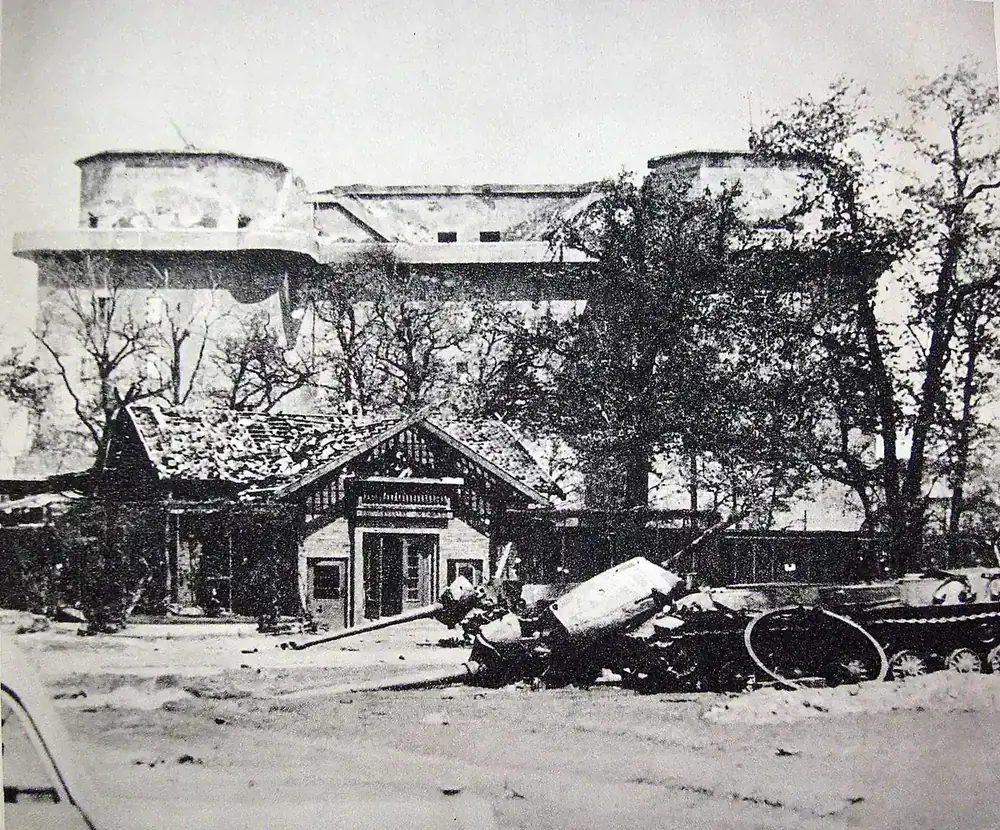
The Zoo flak tower in May 1945, with a knocked-out tank in front. Public domain photograph. Photo: nn, Public domain, via Wikimedia Commons
Flak Tower Questions
What was the purpose of the flak towers in Berlin?
Each pair combined anti-aircraft guns on a G-tower with range-finding in an L-tower, and the structures doubled as air-raid shelters and art storage. The Zoo tower sheltered up to 16,000 civilians during an alarm.
Where were the Berlin flak towers located?
The three pairs stood at the Zoo in the Tiergarten, in Friedrichshain and in Volkspark Humboldthain. Only the Humboldthain ruin survives in enterable form. The locations are compared in the table above.
Can you go inside a flak tower in Berlin?
Yes, only the Humboldthain ruin, and only on the flak tower tour, which is restricted to age 18 and over, requires sturdy closed shoes, forbids photography and is booked online only. Details are on the Berlin underground tours page.
How much does the Humboldthain flak tower tour cost?
Per the operator's 2025 flyer the tour costs €17 (reduced €13) and lasts 90 minutes. The entry ticket is not bundled with any transport. Compare it with the guided options in the Berlin WW2 tours comparison.
Can you see a flak tower without booking a tour?
Yes. The outside of the Humboldthain ruin is freely visible in Volkspark Humboldthain near S+U Gesundbrunnen, and an observation platform stands on the Friedrichshain Bunkerberg mound. The Wall and Third Reich bike tour names the Humboldthain tower among its stops for $39 if you prefer company.
What happened to the flak towers after the war?
The Zoo pair was blown up in 1947 and 1948, using 12 and 40 tonnes of explosives. The Friedrichshain towers were partly demolished in 1946 and buried under rubble hills. Only Humboldthain was left half standing because the Ringbahn line beside it could not be damaged. The fates are set out in the table above.