 Berlin WW2 Tours
House of the Wannsee Conference: Visiting the Wannsee Conference House
The House of the Wannsee Conference is the memorial and education site on the shore of the Grosser Wannsee, where fifteen senior officials met on 20 January 1942 and the protocol listed about 11 million European Jews for 'evacuation'. This guide covers what happened in the villa, what the free permanent exhibition shows, the daily opening hours, how to reach the house by S1 or S7 and bus 114. Admission is free, and free public tours run on weekends. If you want a guided introduction to Nazi Berlin before travelling out, the comparison of Berlin WW2 tours on the homepage is the place to start.
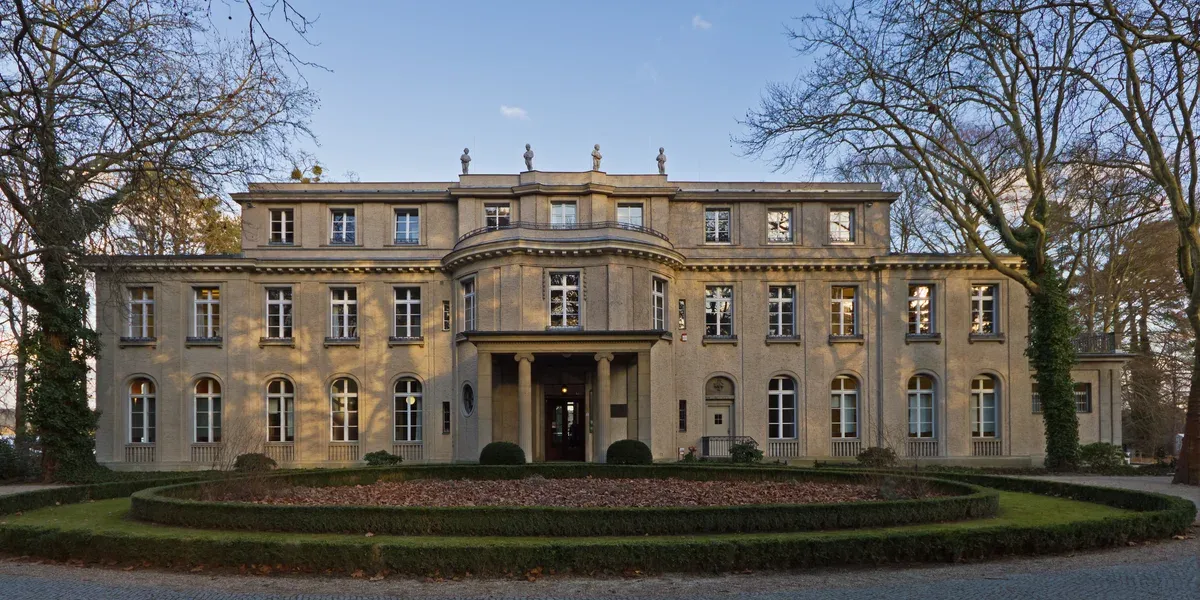
The front of the villa that hosted the Wannsee Conference, with its garden. Photo: A.Savin, CC BY-SA 3.0, via Wikimedia Commons
Quick answer Visiting the Wannsee Conference House
The House of the Wannsee Conference is a memorial and education site at Am Grossen Wannsee 56-58, open daily 10:00 to 18:00 with free admission. It marks the villa where fifteen officials chaired by Reinhard Heydrich met on 20 January 1942 for about 90 minutes. The protocol lists about 11 million European Jews for 'evacuation'.
Key takeaways
- Take the S1 or S7 to Wannsee station and then bus 114 to the stop Haus der Wannsee-Konferenz. Wannsee lies in fare zone B, so a single AB ticket at €4 covers the trip. Details are in the visiting section.
- The permanent exhibition is free and the villa has been a memorial museum since 1992. Read what it shows in the exhibition section.
- Free public tours run on Saturdays and Sundays, and paid seminars and guided tours are available, free for youth, students and trainees.
- Wannsee sits outside the centre and none of the city walks goes there. See making a half day of it and the comparison of WW2 tours in Berlin on the homepage.
Visiting the House: Hours, Admission and Getting There
The memorial is easy to plan around because it opens every day and costs nothing to enter. The figures below come from the memorial's own listings.
Practical Details at a Glance
The house stands at Am Grossen Wannsee 56-58, 14109 Berlin. It is open daily from 10:00 to 18:00. Entry to the permanent exhibition is free.
You need a valid AB ticket for the journey out.
| Item | Detail |
|---|---|
| Address | Am Grossen Wannsee 56-58, 14109 Berlin |
| Opening hours | Daily 10:00 to 18:00 |
| Admission | Free permanent exhibition |
| Public tours | Free on Saturdays and Sundays |
| Seminars and group tours | Paid, free for youth, students and trainees |
| Getting there | S1 or S7 to Wannsee, then bus 114 to Haus der Wannsee-Konferenz |
| Fare zone | B |
| Ticket needed | Single AB ticket, €4, reduced €2.50, valid 2 hours |
The Journey Out
The sources give no visit time. The journey is the S1 or S7 to Wannsee station plus bus 114, which stops at the house. Check current S-Bahn work on the BVG app before you set out.
The app sells tickets as well.
Sources: visitberlin.de, berlin.de transport fares
What Happened on 20 January 1942
The meeting held in this villa on 20 January 1942 took about 90 minutes. The facts below are the documented record.
Fifteen Officials and One Protocol
Fifteen senior officials of the Nazi state and the SS gathered in the villa for a meeting chaired by Reinhard Heydrich. Adolf Eichmann served as recording secretary. The protocol listed about 11 million European Jews for so-called 'evacuation'.
Half of the fifteen attendees were under 40 and only two were over 50. Ten had university degrees, eight held doctorates and eight were lawyers. Cognac was served toward the end of the meeting.
The Copy Found in 1947
Thirty copies of the protocol were made. Copy 16, which belonged to Martin Luther, survived the war. Robert Kempner found it in March 1947.
The Villa After the War
The villa was built in 1914 and 1915 by Paul Baumgarten. Friedrich Minoux bought it in 1921, and in 1940 it was acquired for the SS. It passed to the German Reich in February 1943.
Since 1992 the villa has been a Holocaust memorial museum and education site, open to anyone who wants to learn what was planned here and in whose name.
Sources: Wikipedia, Wannsee Conference, de.wikipedia, Haus der Wannsee-Konferenz
The House of the Wannsee Conference
The US Holocaust Memorial Museum at the villa where the conference met. Third-party video by United States Holocaust Memorial Museum. This site did not shoot it and has no relationship with the creator.
The Exhibition and the Villa
The permanent exhibition is on the ground floor of the villa, and the house runs tours, seminars and a library.
The Permanent Exhibition
The permanent exhibition on the ground floor was updated in 2020. Entry is free.
Tours, Seminars and the Library
Free public tours run on Saturdays and Sundays, and they are the easiest way to get context if your visit falls on a weekend. The house also offers paid seminars and guided tours for groups, which are free for youth, students and trainees, reflecting the site's educational role. The Joseph Wulf Library in the building holds more than 75,000 media items and serves researchers and visitors who want to read further.
If you plan a group visit, contact the memorial in advance through its own site rather than arriving unannounced.
Where Wannsee Fits Among Berlin's Memorials
The Wannsee villa belongs with a group of sites that document the Nazi state and its victims, and several others deserve a place on the same itinerary. The German Resistance Memorial Center in the Bendlerblock commemorates the 1944 plot against Hitler, and Museum Berlin-Karlshorst marks the room where Germany surrendered in 1945. For a wider list of institutions, see the guide to WW2 museums in Berlin.
Each of them is free.
Sources: ghwk.de, visitberlin.de
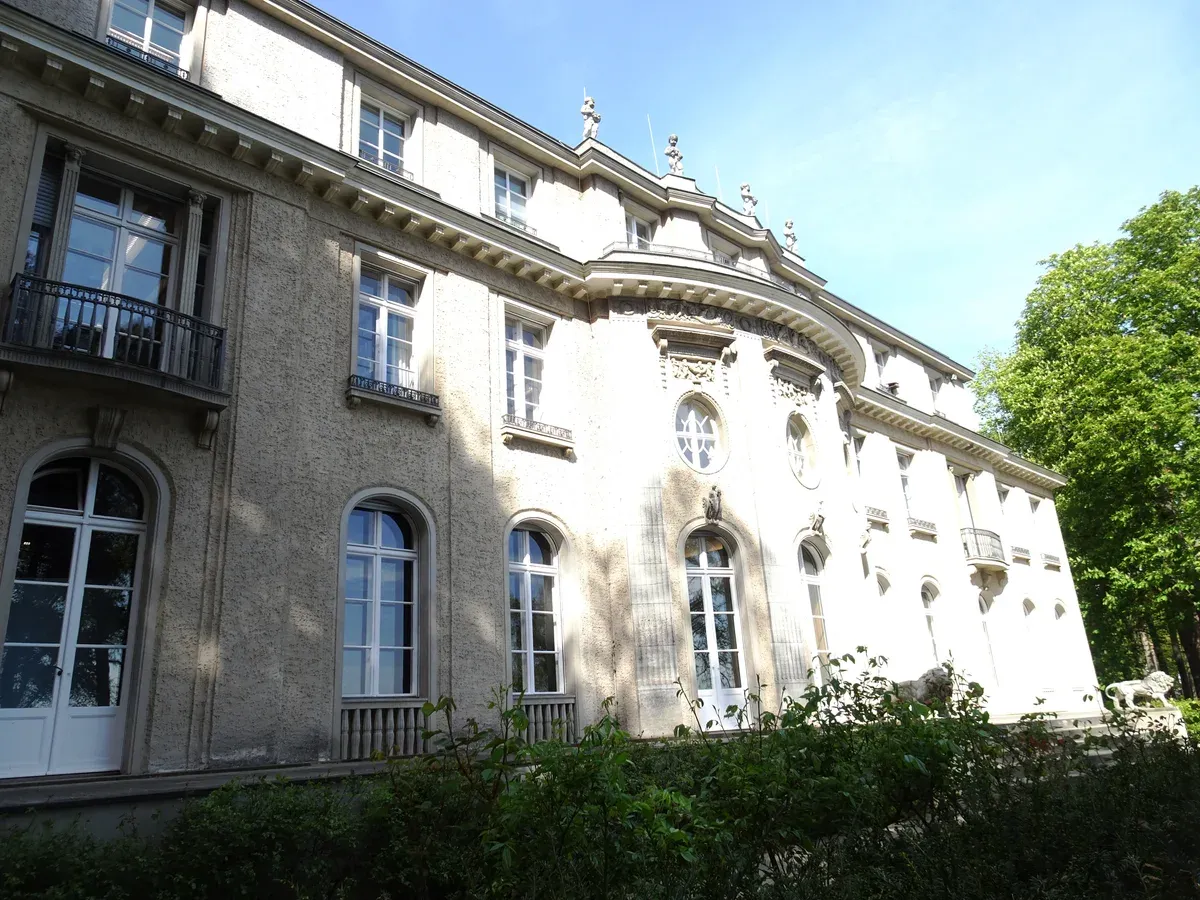
The Villa Marlier seen from the side of the grounds. Photo: Palickap, CC BY-SA 4.0, via Wikimedia Commons
Making a Half Day of It
Wannsee lies in fare zone B, outside the centre.
Going on Your Own
The straightforward way is public transport. Board the S1 or the S7 to Wannsee station, change to bus 114 and ride to the stop Haus der Wannsee-Konferenz. Wannsee is in fare zone B, so a single AB ticket at €4 or a 24-hour AB ticket at €11.20 covers everything.
The 24-hour ticket makes sense if you combine the memorial with other sites the same day.
Why the Bookable Walks Do Not Go There
None of the city walking tours compared on this site travels out to Wannsee. The shared group walks cover the government quarter, Hitler's bunker site and the Topography of Terror, all of which cluster in the centre. The private option on this site is the private walking tour at $194.12, a 3 to 4 hour private walk with hotel pickup and drop-off.
Its route lists Hitler's Bunker site, the German Resistance headquarters, the Reichstag, the Memorial to the Murdered Jews of Europe and the Topography of Terror, and Wannsee is not on it. Ask the operator before booking whether a Wannsee extension fits the 3 or 4 hour format, and check at booking what the per-person price covers.
A Sensible Shape for the Day
Most visitors do best with a simple plan. Travel out, take the free weekend public tour if it is a Saturday or Sunday, and visit the exhibition. If you want guided context for central Berlin first, a walk such as the historian-led small-group tour of at most 10 guests or the three-hour Hitler and WWII walk at $19.66 gives you the government quarter, and you can then visit Wannsee independently the next day.
| Option | Price | Format |
|---|---|---|
| Independent visit by S-Bahn and bus 114 | €4 AB single | Daily 10:00-18:00, free entry |
| Free public tour at the villa | Free | Saturdays and Sundays |
| Private Walking Tour Berlin | $194.12 | Private group, 3-4 hours, hotel pickup |
Sources: visitberlin.de, berlin.de transport fares, tour listings on this site
Where the Same History Is Told in the City
The villa on the Wannsee did not stand alone. The bureaucratic and police apparatus it served was headquartered in central Berlin, and several sites there document the same events from their own ground.
Topography of Terror
The Topography of Terror stands on Niederkirchnerstraße 8, on the block where the Gestapo headquarters, the SS leadership, the SD and, from 1939, the Reich Security Main Office were based from 1933 to 1945. That last institution matters here: Heydrich convened the Wannsee meeting as its chief, and men from this block travelled out to the villa. The permanent exhibition covers the Gestapo, the SS and the Reich Security Main Office, and an outdoor tour of the grounds has 15 stations.
Admission is free and the documentation centre is open daily 10:00 to 20:00, with the outdoor areas accessible until dusk, 20:00 at the latest. The nearest stations are S Anhalter Bahnhof and S+U Potsdamer Platz.
The Information Centre at the Memorial to the Murdered Jews of Europe
The Memorial to the Murdered Jews of Europe at Cora-Berliner-Straße 1 is the national memorial to the people the Wannsee protocol listed for deportation. Its underground Information Centre, about 800 square metres, is open Tuesday to Sunday 10:00 to 18:00, with last admission 45 minutes before closing, and closed Mondays. Admission is free.
Its most direct answer to the anonymous figures in the Wannsee protocol is the Room of Names, which holds the names of about 3 million Jewish victims supplied by Yad Vashem. The field of stelae above is accessible around the clock, and the nearest station is S+U Brandenburger Tor.
Anhalter Bahnhof and the Deportations
The ruined façade of Anhalter Bahnhof, about 600 m southeast of Potsdamer Platz, marks one of Berlin's deportation points. From here, 9,600 Jews were deported to Theresienstadt in 116 trains. The station is also a practical stop on this route: the S1 toward Wannsee runs from here, and the Berlin Story Bunker, a wartime air-raid shelter, stands nearby.
It is one of the sites covered in the guide to WW2 museums in Berlin. A visit to the Wannsee Conference house reads differently once you have seen where the transports began.
Planning Wannsee as a Half Day
The Wannsee Conference house is a half-day trip from the centre. Take the S1 or S7 to Wannsee station, then bus 114 to the stop Haus der Wannsee-Konferenz. Wannsee lies in fare zone B, so a 24-hour ticket AB at €11.20 covers the whole outing and leaves room for the Topography of Terror or the Holocaust Memorial Information Centre on the way back.
Allow the morning or afternoon for the journey, the free permanent exhibition and the lakeside walk, and check the free weekend public tour times on site. If you would rather pair the central sites with context from a guide, a guided WW2 tours in Berlin option such as the private Third Reich walking tour covers the government quarter before you travel out to the lake.
Questions About the Wannsee Conference House
What happened at the House of the Wannsee Conference?
On 20 January 1942, fifteen senior officials chaired by Reinhard Heydrich met in the villa for about 90 minutes, and the protocol lists about 11 million European Jews for 'evacuation'. The full record and the story of the document are set out in the section on the conference.
How much does it cost to visit the Wannsee Conference house?
Admission to the permanent exhibition is free, and public tours on Saturdays and Sundays are free as well. Paid seminars and guided tours are available and are free for youth, students and trainees. You only pay for transport, as explained in the visiting section.
How do I get to the House of the Wannsee Conference?
Take the S1 or the S7 to Wannsee station, then bus 114 to the stop Haus der Wannsee-Konferenz. Wannsee is in fare zone B, so you need an AB ticket, €4 as a single valid for 2 hours. The details are in the getting-there table.
How long should I allow for the Wannsee Conference house?
The sources give no visit time. The suggested shape of the day is in making a half day of it.
Is there a guided tour of the Wannsee Conference villa?
The memorial itself runs free public tours on Saturdays and Sundays, plus paid seminars and group tours. The bookable city walks on Berlin WW2 tours do not go to Wannsee. The private walk at $194.12 does not list it either.
When did the villa become a memorial?
The villa became a Holocaust memorial museum in 1992, and the ground floor exhibition was updated in 2020. Its history between 1915 and 1992 is described in the section on the villa.