 Berlin WW2 Tours
Soviet War Memorials in Berlin: Tiergarten, Treptower Park and the Battle They Mark
A Soviet War Memorial Berlin visitor has two major sites to choose from, in the Tiergarten and in Treptower Park, and a third large cemetery memorial at Schönholzer Heide. All three honour the Red Army soldiers who fell in the Battle of Berlin from 16 April to 2 May 1945, a battle that cost the Soviet side 81,116 dead or missing. This guide sets out what stands at each site, when each was built, how to reach them, how much time to allow, and which Berlin WW2 tours stop at them. No admission fee is stated for any of the three, and all are open outdoor sites.
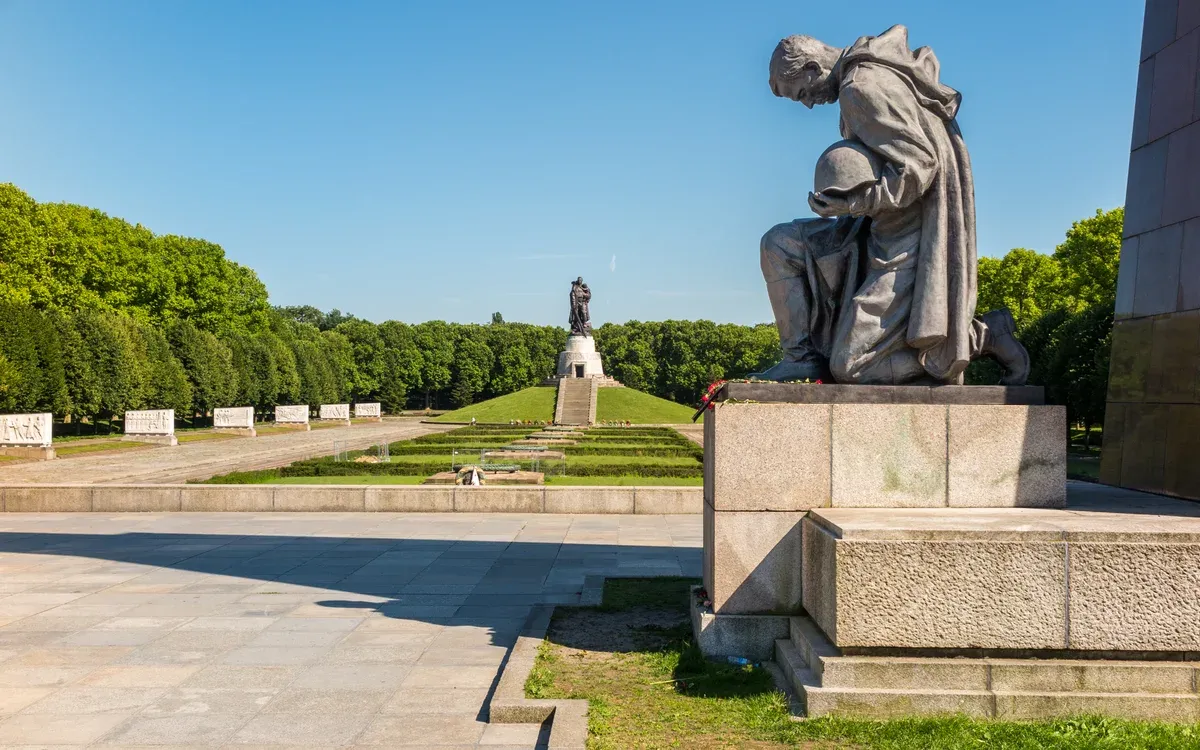
The kneeling soldier figure at the Soviet War Memorial in Treptower Park, with the main memorial far behind. Photo: JoachimKohler-HB, CC BY-SA 4.0, via Wikimedia Commons
Quick answer The Soviet war memorials at a glance
Berlin has three large Soviet War Memorial sites. The best known are in the Tiergarten (unveiled 11 November 1945, more than 2,000 soldiers buried there per its sign) and in Treptower Park (opened 8 May 1949, a 12 m bronze soldier and 16 sarcophagi). No admission fee is stated for either, and both are open-air sites.
Key takeaways
- The Tiergarten memorial sits on Straße des 17. Juni with a direct view of the Reichstag, and the 2-hour Third Reich and Cold War walk stops there.
- Treptower Park has a 12 m bronze soldier statue and 16 stone sarcophagi, one per Soviet republic of the time.
- The memorials mark the Battle of Berlin, 16 April to 2 May 1945, which cost the Soviets 361,367 casualties including 81,116 dead or missing.
- To walk the battle sites around the Reichstag and Moltke Bridge with beer tastings, see the Beers and Battlefields tour at $78.
The Memorials Side by Side
Three Soviet war memorials stand in Berlin today, and each has a different character and setting.
Which One Should You Visit
The table below compares the three sites on opening date, what physically stands there, and the transport situation. The figures come from the source listings for each memorial. If you have time for only one, Treptower Park has the 12 m bronze soldier and the 16 sarcophagi. If you want a short stop in the government quarter, the Tiergarten memorial sits on Straße des 17. Juni between the Brandenburg Gate and the Reichstag. Schönholzer Heide in Pankow is the largest Soviet cemetery in Berlin by burials, with 13,200 soldiers. No admission fee is stated for any of the three.
One more site belongs to the same story. The German surrender of 8 May 1945 was ratified in Karlshorst, and that building is now a museum. It has its own page at Museum Berlin-Karlshorst, so it is only summarised there and not covered further on this page.
| Memorial | Opened | What is there | Station |
|---|---|---|---|
| Soviet War Memorial Tiergarten | Unveiled 11 November 1945 | Two T-34 tanks and two ML-20 howitzer-guns, stone from the Reich Chancellery, more than 2,000 buried per the memorial's sign | No station stated. It stands on the north side of Straße des 17. Juni. |
| Soviet War Memorial Treptower Park | Opened 8 May 1949 | A 12 m bronze soldier, 16 stone sarcophagi and two 2.5 m flame bowls, about 5,000 interred and 7,000 commemorated (two figures are given) | No station stated |
| Soviet War Memorial Schönholzer Heide | Built May 1947 to November 1949 | A 33.5 m syenite obelisk with an Honor Hall, eight burial chambers with 1,182 soldiers, 13,200 burials in total, the largest Soviet cemetery in Berlin | not stated |
Why Germany Maintains Them
The 1990 Treaty on the Final Settlement obliges Germany to maintain Soviet war graves. The Two Plus Four agreement also requires Germany to consult Russia before changing the Treptower Park memorial. These are not informal remembrance sites.
The treaty protects the graves. The Treptower statue was refurbished in 2003-2004 at a cost of about €1.5 million, with 2,200 screws replaced and a stainless steel frame added.
Soviet War Memorial Tiergarten
A Soviet memorial unveiled months after the war ended, and easy to fit into a walk through the government quarter.
What Stands There
The Tiergarten memorial was unveiled on 11 November 1945, only months after the war ended. It was built from stone salvaged from the Reich Chancellery, the seat of the Nazi government. The architect was Mikhail Gorvits, working with sculptors Vladimir Tsigal and Lev Kerbel.
The memorial displays two T-34 tanks and two ML-20 howitzer-guns. Per the memorial's own sign, more than 2,000 soldiers are buried there. It commemorates the roughly 80,000 Soviet soldiers killed in the Battle of Berlin as a whole.
The View of the Reichstag
The memorial lies on the north side of Straße des 17. Juni with sight of the Reichstag and the Brandenburg Gate. Soviet soldiers left graffiti in the Reichstag in 1945, and part of it was preserved in the restoration. Yevgeny Khaldei took the flag photograph there on 2 May 1945. Standing at the memorial and looking toward the Reichstag connects the two points of the same story, the commemoration and the battlefield.
The memorial stands in what became the British sector of West Berlin. Soviet honour guards from East Berlin's 6th Separate Guards Motor Rifle Brigade stood watch here through the Cold War, and after 1961 British soldiers protected the memorial from West Berlin protesters. It was vandalised in 2010 shortly before 8 May.
Visiting and Tours That Stop Here
No admission fee is stated and no station is given for it, but the memorial sits between the Brandenburg Gate and the Reichstag. The walk from the Brandenburg Gate to the Reichstag is about 291 m, roughly 4 minutes on foot. Three guided tours in this comparison include the memorial in their route. The 2-hour Third Reich and Cold War walk at $27 starts at the Brandenburg Gate and covers the memorial, the Reichstag, the Holocaust Memorial and Hitler's bunker site. The 3-hour Hitler and WWII walk at $19.66 also lists the Soviet War Memorial between the bunker site and Wilhelmstrasse.
For a historian-led small group of at most 10, Hitler's Berlin at $51 covers nine sites including the memorial.
- Unveiled 11 November 1945
- Stone salvaged from the Reich Chancellery
- Two T-34 tanks and two ML-20 howitzer-guns
- More than 2,000 soldiers buried per the memorial's sign
- No admission fee stated, open-air
Exploring Treptower Park's Soviet War Memorial
A walk through the Soviet War Memorial in Treptower Park. Third-party video by Decades. This site did not shoot it and has no relationship with the creator.
Soviet War Memorial Treptower Park
The central war memorial of East Germany through the division of the country.
The Layout
The Treptower Park memorial opened on 8 May 1949, the fourth anniversary of the German surrender, which was signed at Karlshorst on that date. A competition drew 33 entries. Building took over three years with about 1,200 workers, 200 stonemasons and 90 sculptors. The architect Yakov Belopolsky led the design team and Yevgeny Vuchetich made the statue. The sculptures and the 2.5 m flame bowls were cast in 1948 at Lauchhammer.
The memorial has 16 stone sarcophagi, one per Soviet republic of the time, and a 12 m bronze statue of a Soviet soldier. The figure recalls Sergeant Nikolai Masalov, who rescued a German child. About 5,000 soldiers are interred here, while the memorial commemorates 7,000 of the 80,000 Red Army dead of the battle, and both figures are worth knowing before you go.
Time to Walk It and How to Get There
No walking time and no station are stated in the sources. No admission fee is stated and the site is open-air.
The 2003-2004 restoration cost about €1.5 million and added a stainless steel frame. Under the Two Plus Four agreement, Germany must consult Russia before changing the memorial. If you are comparing the two main sites, Treptower Park rewards more time, and the Tiergarten memorial rewards location. No admission fee is stated for either. A single AB ticket is €4 (reduced €2.50) and valid for 2 hours.
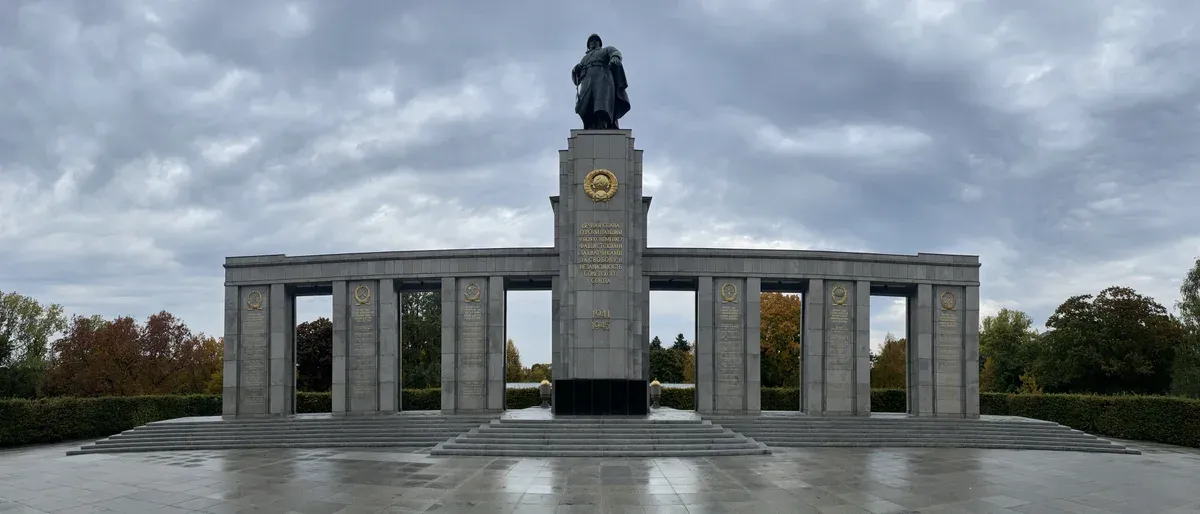
The colonnade, steps and bronze soldier of the Soviet War Memorial in Tiergarten. Photo: Anil Öztas, CC BY-SA 4.0, via Wikimedia Commons
The Battle of Berlin They Commemorate
Both memorials are grave sites of one battle, and the numbers behind them explain their scale.
The Cost of the Battle
The Battle of Berlin ran from 16 April to 2 May 1945. Hitler died on 30 April 1945, and General Weidling oversaw the surrender of the city on 2 May 1945. The German surrender was signed at Karlshorst on 8 May 1945, recorded as 9 May in Soviet records.
The human cost was enormous on every side. Soviet casualties were 361,367, including 81,116 dead or missing. German military dead were 92,000 to 100,000, with about 125,000 civilian dead.
The Tiergarten memorial commemorates about 80,000 Soviet dead of the battle as a whole, and Treptower Park commemorates 7,000 of them at its own grounds. These figures are the reason the memorials are cemeteries first and monuments second.
Walking the Battle Sites Today
Several battle sites around the government quarter can be seen on a bookable walk. The Beers and Battlefields walk covers exactly that ground. It is a 3.5-hour walk through the Reichstag, Brandenburg Gate, Tranenpalast, Boros Bunker and Moltke Bridge, run by Birchy's Berlin Tours, with beer tastings at three local bars. It costs $78, takes small groups, is not suitable for anyone under 18, and requires ID for alcohol verification. The meeting point is Ebertstrasse 24. Meals, transportation to the start and gratuities are not included.
If you prefer the same ground without the bars, the 2-hour walk from the Brandenburg Gate takes in the Soviet War Memorial in the Tiergarten along with the Reichstag and the bunker site. For a deeper independent day, the Berlin WW2 itinerary strings the battle and Third Reich sites into one route.
The Surrender and Its Museum
One line suffices here, because the subject has its own page. The unconditional surrender was ratified on 8 May 1945 in the officers' mess of a Wehrmacht pioneer school in Karlshorst, and the room is preserved. Admission to Museum Berlin-Karlshorst is free, it is open Tuesday to Sunday 10:00 to 18:00, and an audio guide costs €3.
The visit pairs naturally with the Treptower memorial, which opened on the surrender's fourth anniversary.
Questions About the Soviet War Memorials in Berlin
Is the Soviet War Memorial in Berlin free to visit?
No admission fee is stated for any of the three sites, and all are open-air memorials. The Tiergarten memorial is one stop on the 2-hour Third Reich and Cold War walk at $27 if you want context from a guide.
How many Soviet soldiers are buried at the Berlin memorials?
More than 2,000 are buried at the Tiergarten memorial per its sign. At Treptower Park about 5,000 are interred while the memorial commemorates 7,000 of the battle's dead, so both figures should be quoted together. The largest Soviet cemetery in Berlin is Schönholzer Heide, with 13,200 burials.
What is the biggest war memorial among the Soviet sites in Berlin?
Treptower Park has a 12 m bronze soldier and 16 sarcophagi, and it took about 1,200 workers and 90 sculptors over three years to build. Schönholzer Heide has the most burials. See the comparison table above or the Beers and Battlefields walk for the battle sites themselves.
Why was the Tiergarten memorial built from Reich Chancellery stone?
The memorial was built from stone salvaged from the Reich Chancellery, the destroyed seat of the Nazi government, and unveiled on 11 November 1945. Soviet forces had levelled the Chancellery buildings between 1945 and 1949. The 3-hour Hitler and WWII walking tour links the memorial with the government quarter it came from.
Which Soviet war memorial is easiest to reach from central Berlin?
The Tiergarten memorial, because it stands on the north side of Straße des 17. Juni between the Brandenburg Gate and the Reichstag. For a full self-guided day, the Berlin WW2 itinerary sequences these sites.
Did the Soviets control Berlin after the war?
The Red Army took the city in the battle of 16 April to 2 May 1945 at a cost of 81,116 dead or missing, and the Soviet Military Administration had its headquarters in the Karlshorst building after 1945. The city was later divided into sectors, and the Tiergarten memorial ended up in the British sector while Soviet honour guards still stood watch there. The surrender room itself is covered on the Museum Berlin-Karlshorst page.