 Berlin WW2 Tours
Museum Berlin-Karlshorst: Visiting the Room Where Germany Surrendered
Museum Berlin-Karlshorst stands in the building where the German unconditional surrender was ratified on 8 May 1945. Admission is free, the doors are open Tuesday to Sunday from 10:00 to 18:00, and the original surrender room is preserved with a film of the signing. This guide covers the history of the officers' mess, the permanent exhibition on German-Soviet relations from 1917 to 1990, audio guides at €3, access by S3 and bus 296 or U5 to Tierpark, and how to combine Karlshorst with Treptower Park. If you would rather see the end of the Battle of Berlin in the centre with a guide, the Berlin WWII tours on the homepage lists every bookable option.
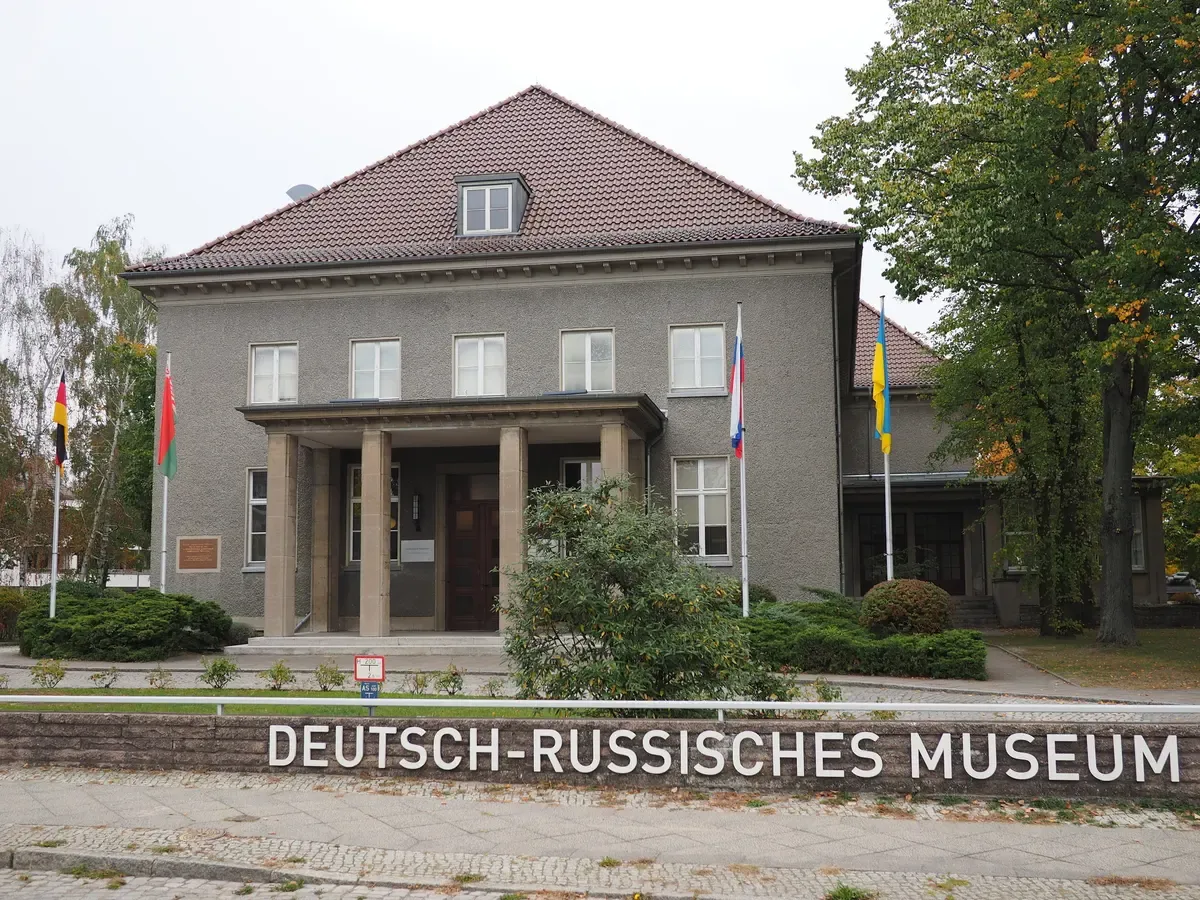
The entrance of the German-Russian Museum Berlin-Karlshorst with its name lettered on the forecourt wall. Photo: Nick-D, CC BY-SA 4.0, via Wikimedia Commons
Quick answer Museum Berlin-Karlshorst at a glance
Museum Berlin-Karlshorst, founded in 1995 as a German-Russian institution, is free to enter and open Tuesday to Sunday from 10:00 to 18:00, closed Mondays. It occupies the former officers' mess where the German unconditional surrender was ratified on 8 May 1945, and 9 May in Soviet records.
Key takeaways
- The preserved surrender room shows a film of the signing, and admission costs nothing. Details in the visiting section.
- The permanent exhibition covers about 1,000 square metres of German-Soviet history from 1917 to 1990. See the exhibition.
- Reach it by S3 to Karlshorst plus bus 296, about 32 minutes from central Berlin, or U5 to Tierpark plus bus 296, about 28 minutes from Alexanderplatz.
- To see the end of the battle in the centre with a guide, consider the Beers and Battlefields walk, or browse the WW2 tours in Berlin on the homepage.
Visiting Karlshorst
The museum is in Berlin-Karlshorst, outside the centre. All figures below come from the museum's own visitor page.
Hours, Admission and Getting There
The practical case for Karlshorst is simple. Entry is free, the building has lift and ramp access and wheelchairs can be borrowed, and an audio guide in seven languages costs €3, reduced €1. The trip from central Berlin takes about half an hour. Take the S3 to Karlshorst and change to bus 296, about 32 minutes from the centre, or take the U5 to Tierpark and bus 296, about 28 minutes from Alexanderplatz. A single AB ticket costs €4 (€2.50 reduced) and is valid for 2 hours. No tour on this site includes Karlshorst, so this is a do-it-yourself visit.
The city walks compared on the homepage stay in the Mitte and government quarter. For the far east of the city you plan the trip yourself.
| Item | Detail |
|---|---|
| Address | Zwieseler Straße 4, 10318 Berlin-Karlshorst |
| Admission | Free |
| Hours | Tuesday to Sunday 10:00-18:00, closed Mondays |
| Closures | 24 December, 31 December, 1 January |
| Audio guide | €3 (reduced €1), seven languages |
| Access | Lift and ramp access, wheelchair loans |
| By train | S3 to Karlshorst, then bus 296, about 32 minutes from central Berlin |
| Alternative | U5 to Tierpark, then bus 296, about 28 minutes from Alexanderplatz |
| Phone | +49 (0)30 501 508-10 |
The Building and Its Afterlife
The house was built as the officers' mess of the Wehrmacht pioneer school. After the surrender it became the headquarters of the Soviet Military Administration. In 1949 the Soviet Army handed power to the GDR government in this building. A branch of the Soviet armed forces museum ran here from 1967 to 1994. The German-Russian museum opened in May 1995 as a binational institution. Today the permanent exhibition draws about 40,000 visitors a year.
A Soviet T-34 tank stands on a pedestal on the grounds, and the open-air exhibition 'The German Surrender in May 1945' is ongoing.
Sources: Museum Berlin-Karlshorst
The Surrender of 8 May 1945
This is the reason most visitors make the trip east. The signing happened here, in this building, and the room survives.
Where the German Surrender Was Signed
The German unconditional surrender was ratified in this building on 8 May 1945. Soviet records date the act to 9 May. The building was then the officers' mess of the Wehrmacht pioneer school.
What the museum itself states is the core fact: the original surrender room is preserved. It shows a film of the signing. The Battle of Berlin itself ran from 16 April to 2 May 1945, and General Weidling oversaw the surrender of the city on 2 May, days before the ratification here. Soviet casualties in the battle were 361,367, including 81,116 dead or missing, and German military dead were 92,000 to 100,000 with about 125,000 civilian dead.
Surrender in Berlin-Karlshorst: First Hand, May 8 1945
The museum's own film on the surrender of 8 May 1945. Third-party video by Museum Berlin-Karlshorst. This site did not shoot it and has no relationship with the creator.
The Permanent Exhibition
Beyond the surrender room, the museum covers German-Soviet relations from 1917 to 1990.
German-Soviet Relations 1917-1990
The permanent exhibition covers about 1,000 square metres and German-Soviet relations from 1917 to 1990.
The audio guide costs €3 (reduced €1) and comes in seven languages. Among WW2 museums in Berlin, it is the one where the event itself happened in the building. If you want more museums with entry prices and hours in one place, the homepage lists them under museums and memorials hours.
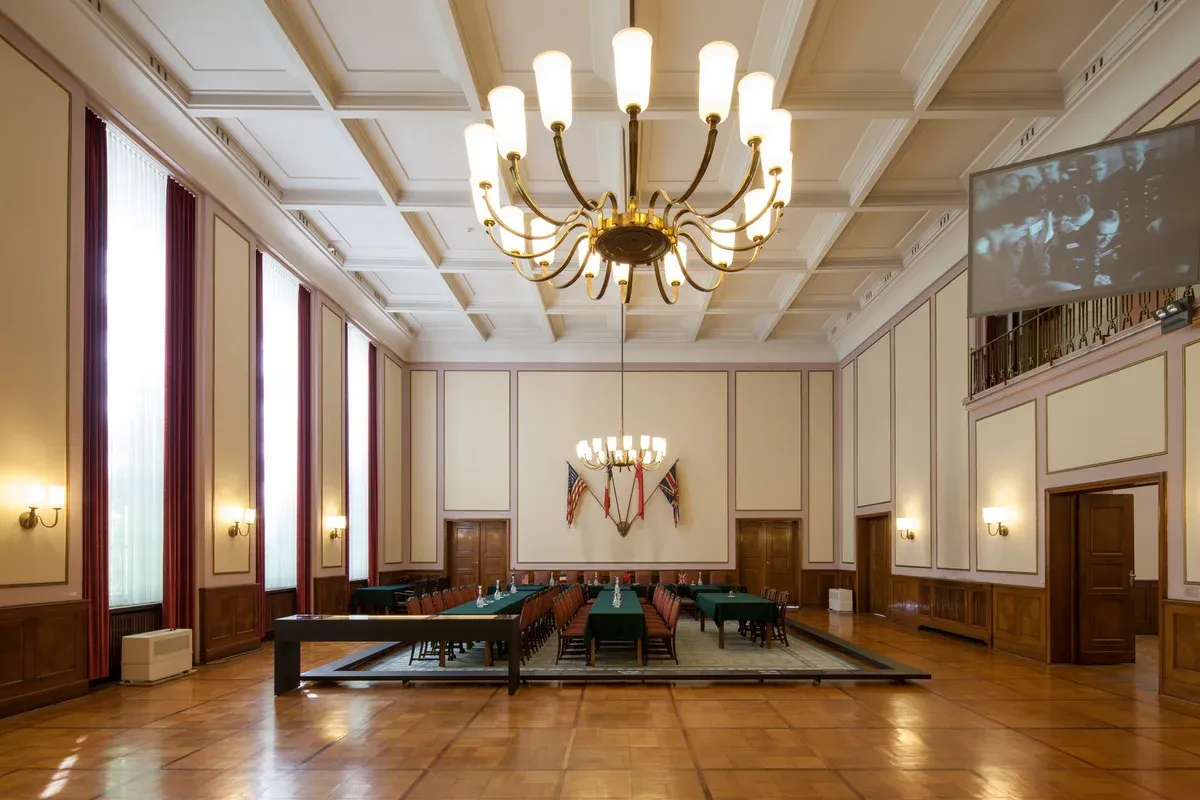
The historic surrender hall where the Wehrmacht capitulation was signed on 8 May 1945. Photo: Thomas Bruns, CC BY-SA 4.0, via Wikimedia Commons
Combining Karlshorst with Treptower Park
Karlshorst and Treptower Park both lie in the east of Berlin, and a day can join the surrender room with the Soviet War Memorial in Treptower Park.
A Day in the East
The Soviet memorials of Berlin are covered in full on their own page. In brief, the Soviet War Memorial in Treptower Park opened on 8 May 1949, four years to the day after the ratification at Karlshorst. It carries a 12 m bronze statue of a Soviet soldier and 16 stone sarcophagi, one for each Soviet republic of the time. The two sites share a theme: the Soviet defeat of Nazi Germany and its cost.
No walk on this site serves this corner of the city, and the guided city walks do not come this far east.
For the end of the battle in the centre instead, the Beers and Battlefields walk covers the Reichstag, Brandenburg Gate and Moltke Bridge in 3.5 hours for $78, with small groups and a 5 rating from 77 reviews. Guests must be 18 and bring ID. It is run by Birchy's Berlin Tours and starts at Ebertstrasse 24. If you prefer a walk without beer, the Third Reich walking tours on the homepage cover the government quarter on foot.
Before You Go: Time, Access and the Wider Story
Practical planning for Museum Berlin-Karlshorst, plus the history that gives the site its meaning.
How Long a Visit Takes and What to See First
Start with the surrender room. It is the preserved room where the German unconditional surrender was ratified on 8 May 1945, and a film of the signing is shown there. Nothing else in Berlin shows the moment in the same place where it happened.
After the surrender room, walk through the permanent exhibition. It covers German-Soviet relations from 1917 to 1990 across about 1,000 square metres, so allow time for it. An open-air exhibition on the grounds, 'The German Surrender in May 1945', is ongoing, and a Soviet T-34 tank stands on a pedestal outside.
Admission is free, and the museum is open Tuesday-Sunday 10:00-18:00 and closed Mondays, as well as on 24 December, 31 December and 1 January. A careful visit to the room, the main exhibition and the grounds fits comfortably into two to three hours. If you want to build a full day of museum visits, see the other WW2 museums in Berlin or compare Berlin WW2 tours for guided options.
Access and Facilities
The building has lift and ramp access, and wheelchairs can be borrowed on site. Audio guides cost €3 (reduced €1) and are available in seven languages. Admission itself is free, so the audio guide is the only cost most visitors will pay.
Getting there takes a bit of planning because Karlshorst is well outside the centre. The standard route is the S3 to Karlshorst, then bus 296, which the museum puts at about 32 minutes from central Berlin. An alternative is the U5 to Tierpark and then bus 296, about 28 minutes from Alexanderplatz. A single AB ticket costs €4 (reduced €2.50) and is valid for 2 hours, which covers either route. Tickets are sold at machines and through the BVG app.
The museum is at Zwieseler Straße 4 in Berlin-Karlshorst, and its phone number is +49 (0)30 501 508-10. Note that the museum itself offers no guided tour products sold through booking platforms. If you prefer context from a guide on the government quarter and battle sites in the centre instead, the Berlin Beers and Battlefields Tour: War History and German Beer covers Battle of Berlin sites in Mitte for $78, and the Private Walking Tour Berlin: Third Reich, Hitler and World War II runs 3-4 hours with hotel pickup.
How Karlshorst Fits the End of the War in Berlin
The Battle of Berlin ran from 16 April to 2 May 1945. Hitler died on 30 April, and General Weidling oversaw the surrender of Berlin on 2 May 1945. The costs were enormous: Soviet casualties were 361,367 including 81,116 dead or missing, with German military dead of 92,000-100,000 and about 125,000 civilian dead.
The surrender of the city was not the end of the war. That came at Karlshorst, where the German unconditional surrender was ratified on 8 May 1945, which is 9 May in Soviet records. The building had been the officers' mess of the Wehrmacht pioneer school, and after the war it served as the headquarters of the Soviet Military Administration before the Soviet Army handed power to the GDR government there in 1949.
Understanding that sequence makes a visit here more than a museum stop. It is the room where the war in Europe formally ended. The commemorations of the fighting itself stand elsewhere in the city: the Soviet war memorials in Berlin, including Treptower Park and the Tiergarten memorial, mark the roughly 80,000 Soviet soldiers killed in the Battle of Berlin. Pairing Karlshorst with one of those memorials, or with the surrender story told in WW2 museums in Berlin, gives the fullest picture of how the war ended.
Questions About Museum Berlin-Karlshorst
Is Museum Berlin-Karlshorst free?
Yes. Admission to the museum is free, and only the audio guide costs money, at €3 or €1 reduced. A single AB ticket is €4. For other free memorials, see the German Resistance Memorial Center.
Where was the German surrender signed?
The German unconditional surrender was ratified on 8 May 1945 in what is now Museum Berlin-Karlshorst, at Zwieseler Straße 4 in Berlin-Karlshorst. Soviet records date it to 9 May. The original surrender room is preserved and shows a film of the signing.
What are the opening hours of Museum Berlin-Karlshorst?
The museum is open Tuesday to Sunday from 10:00 to 18:00 and closed on Mondays, 24 December, 31 December and 1 January. Check the museums and memorials hours section on the homepage when planning a multi-stop day.
How do I get to Museum Berlin-Karlshorst?
Take the S3 to Karlshorst and change to bus 296, about 32 minutes from central Berlin, or take the U5 to Tierpark and bus 296, about 28 minutes from Alexanderplatz. The museum publishes both routes on its visitor page. A single AB ticket costs €4 (€2.50 reduced).
Is the museum accessible for wheelchair users?
Yes. The building has lift and ramp access and wheelchairs can be borrowed on site. See also the WW2 museums in Berlin.
Is there a guided tour that includes Karlshorst?
No tour compared on this site travels to Karlshorst. The bookable walks stay in central Berlin, such as the Beers and Battlefields walk at $78 or the historian-led small-group walk. Karlshorst is a visit you make on your own, and the WW2 sites you can see on your own section on the homepage helps with that kind of planning.