 Berlin WW2 Tours
Hitler's Bunker in Berlin: Where It Was and What You Can See Today
Hitler's bunker in Berlin is one of the most asked-about sites of the Third Reich, and one of the easiest to miss. The Führerbunker lay about 8.5 m (28 ft) below the garden of the old Reich Chancellery, yet nothing of it is visible today. The ground above is a residential car park, marked only by a single information board. This guide explains where the bunker stood, what it was built as, what happened in it in the last weeks of the war, why it was demolished, and how to find the board on foot. It also lists the places nearby where you can see and learn more, including a full-size replica in the Berlin Story Bunker and the guided walks that stop at the site. You can also compare Berlin WW2 tours if you prefer to walk the area with a guide.
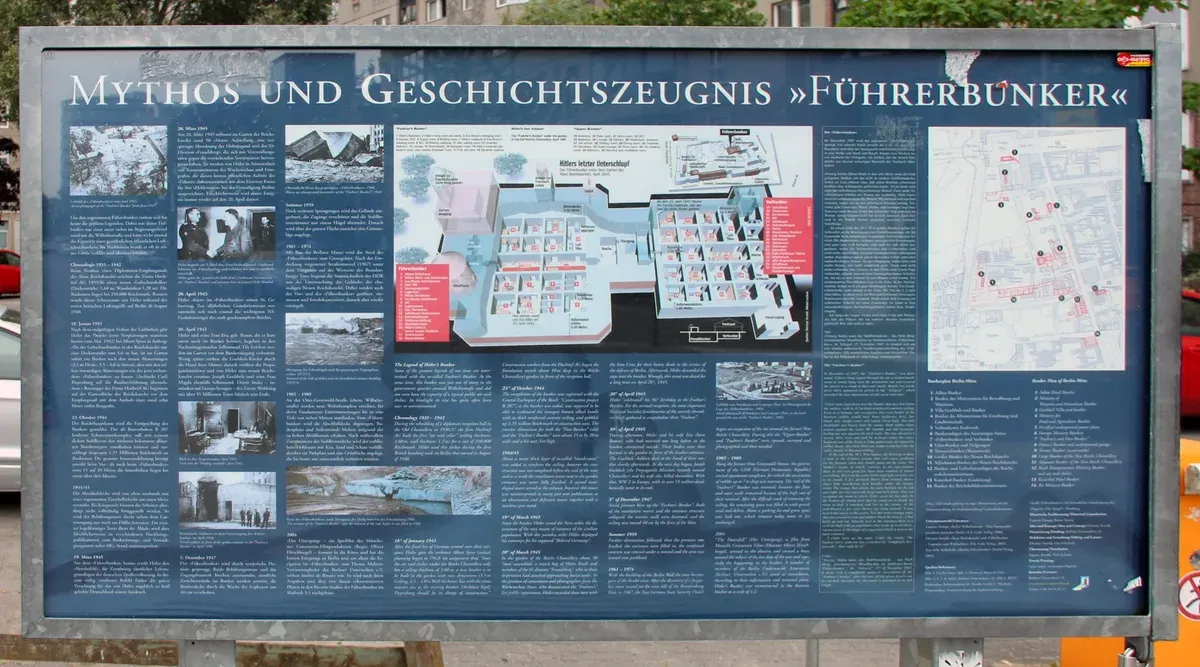
The information board on Gertrud-Kolmar-Strasse that marks where Hitler's bunker lay. Photo: OTFW, Berlin, CC BY-SA 3.0, via Wikimedia Commons
Quick answer Hitler's bunker site today in brief
Hitler's bunker in Berlin lay about 8.5 m (28 ft) below the garden of the old Reich Chancellery, near today's Potsdamer Platz. The site is now a residential car park at Gertrud-Kolmar-Strasse. Nothing of the bunker is visible and there is no access. A single information board in German and English, installed on 8 June 2006, marks the spot.
Key takeaways
- The board stands at Gertrud-Kolmar-Strasse and In den Ministergärten, about 3 minutes' walk from Potsdamer Platz. You can reach it yourself, or on a guided Third Reich Berlin walking tour.
- To see what the inside looked like, visit the full-size Führerbunker replica in the Berlin Story Bunker, about 8 minutes' walk from the Topography of Terror.
- For the history of the site and the last weeks of the war, keep reading the sections below, starting with where the bunker was.
- Planning a wider visit? The Berlin WW2 tours comparison lists the walks that stop at the board.
Where Was Hitler's Bunker?
The Führerbunker lay in the garden of the old Reich Chancellery, in Berlin's government quarter. The address of the marker today is Gertrud-Kolmar-Strasse, 10117 Berlin.
The Exact Location
The bunker sat about 8.5 m (28 ft) below the garden of the old Reich Chancellery at Wilhelmstrasse 77. The main Führerbunker itself lay about 120 m north of the new Reich Chancellery building at Voßstrasse 6, and about 2.5 m lower than the older Vorbunker, to its west-southwest.
The information board that marks the site today stands at the corner of In den Ministergärten and Gertrud-Kolmar-Strasse. This is a residential street with a car park, not a museum site. The address is Gertrud-Kolmar-Strasse, 10117 Berlin.
Finding the Board on Foot
The board is about 3 minutes' walk from Potsdamer Platz. From Potsdamer Platz, head for Gertrud-Kolmar-Strasse and look for the corner with In den Ministergärten. From the Memorial to the Murdered Jews of Europe at Cora-Berliner-Strasse 1, the walk to the bunker site is about 451 m, roughly 6 minutes. From the Brandenburg Gate it is about 781 m, roughly 10 minutes.
Potsdamer Platz is the S+U station to use. A single AB ticket costs €4 (reduced €2.50) if you arrive by public transport, and a short trip ticket costs €2.80. Most people reach the site on foot from Potsdamer Platz or from the Holocaust Memorial.
What You See When You Get There
You see a car park and apartment buildings. There is nothing to enter and no ruin to inspect. The one feature is a single information board, in German and English, which shows a schematic of the bunker so you can relate the drawing to the ground you are standing on. That is the whole visit to Hitler's bunker today, and it takes most people only a few minutes.
If that feels thin, the honest advice is to combine the board with the sites around it. The Topography of Terror documentation centre on Niederkirchnerstrasse is free and open daily 10:00 to 20:00, and is about 843 m, roughly 11 minutes' walk from the bunker site. Guided walks such as the historian-led Third Reich tour stand at the board and put it in context with the rest of the government quarter.
Sources: Topography of Terror, Sachsenhausen Memorial
What the Führerbunker Was
Hitler's bunker was not one structure but two, built years apart and linked underground. The figures below come from the standard historical record of the site.
Two Bunkers, Vorbunker and Führerbunker
The Vorbunker, the forward bunker, was built in 1936. It lay 1.5 m beneath the cellar of a large reception hall behind the old Reich Chancellery. The main Führerbunker was completed in 1944 by the construction firm Hochtief AG, at a recorded cost of 1,349,899.29 Reichsmark. It sat 2.5 m lower than the Vorbunker.
A stairway set at right angles linked the two, and a bulkhead with a steel door could close them off from each other. The whole complex held about 30 small rooms protected by roughly 4 m of concrete. The Führerbunker itself lay about 8.5 m below ground and its roof was nearly 3 m (about 9 ft 10 in) of concrete. Because it sat below the water table, pumps had to run continuously to remove groundwater.
Rooms, Supplies and Communications
Electricity came from a diesel generator and water was pumped from a well. The bunker had a telex line, a telephone switchboard and an army radio set with an outdoor antenna. Hitler's bedroom adjoined his study, and Eva Braun had her own bedroom and sitting room. A briefing and situation room had a door to the waiting areas.
By early 1945 the rooms held furniture brought from the Chancellery and several framed oil paintings, including a large portrait of Frederick the Great. It was a command post and a residence while the Battle of Berlin closed in. The battle ran from 16 April to 2 May 1945 and cost the Soviet side 361,367 casualties including 81,116 dead or missing, with German military dead of 92,000 to 100,000 and about 125,000 civilian dead.
The Last Weeks, in Dates
The table pulls together the dated events in the bunker's history, from its construction through the end of the war to the demolition attempts and the marking of the site. The dates come from the standard historical record of the Führerbunker and the surrounding area.
| Date | What happened |
|---|---|
| 1936 | The Vorbunker was built beneath the cellar of the old Reich Chancellery reception hall. |
| 1944 | Hochtief AG completed the main Führerbunker, about 2.5 m lower than the Vorbunker. |
| 16 January 1945 | Hitler moved into the bunker. |
| 28-29 April 1945 | Hitler married Eva Braun in a small civil ceremony in the bunker, after midnight. |
| 30 April 1945 | Hitler shot himself at around 15:30 and Eva Braun took cyanide. |
| 2 May 1945 | General Weidling oversaw the surrender of Berlin, ending the battle. |
| December 1947 | A Soviet demolition attempt damaged only the separation walls. |
| 1959 | More extensive demolition took place under East German authorities. |
| 1988-89 | Work on the area destroyed most remaining sections of the bunker. |
| 8 June 2006 | A single information board was installed at the site before the FIFA World Cup. |
The Goebbels Family in the Vorbunker
Joseph Goebbels, Hitler's propaganda minister, moved into the upper Vorbunker in April 1945 with his wife Magda and their six children. After Hitler's death on 30 April 1945, the bodies of the six Goebbels children were discovered on 3 May 1945, they had been poisoned. The children's deaths in the bunker complex are part of the record of its last days, and this page states them plainly.
If you want these weeks explained in sequence on the ground, the 3-hour Hitler and WWII walking tour starts at Friedrichstrasse station and covers the bunker site and Wilhelmstrasse, and the Berlin Story Bunker entry ticket gives you the exhibition Hitler, How Could It Happen in a real wartime shelter.
The Nazi Bunkers Hidden Underneath Berlin
A BBC report from the bunkers that still lie under Berlin and what became of them. Third-party video by BBC Global. This site did not shoot it and has no relationship with the creator.
Does Hitler's Bunker Still Exist?
The honest answer is no. The bunker was demolished and the site was built over. Nothing can be visited underground.
Demolished and Sealed
Soviet forces levelled the Chancellery buildings between 1945 and 1949. Attempts to demolish the bunker itself followed in December 1947, when the blast damaged only the separation walls, and again in 1959 under East German authorities. During works in 1988-89 on the area, most of the remaining sections were destroyed. Nothing below ground is open to visitors.
So if you were hoping to stand inside Hitler's bunker, you cannot. No tour in Berlin enters it, because there is no entrance. Any operator claiming otherwise should be treated with caution.
A Car Park, and Why It Stayed Unmarked
Today the site is a residential car park serving the apartment buildings around Gertrud-Kolmar-Strasse. For decades the city left it unmarked. The site stayed unmarked until 8 June 2006, shortly before the FIFA World Cup, when a single information board was finally installed.
The board is modest by design. It is in German and English and shows a schematic drawing of the bunker, so you can see how the two structures sat below the garden. It states the facts without ceremony, and the visit takes minutes rather than an hour.
Seeing More Than a Board
Several options add depth to a visit. First, the Berlin Story Bunker near Anhalter Bahnhof displays a full-size replica of Hitler's bunker office and a 1:25 scale model of the Führerbunker, inside the exhibition Hitler, How Could It Happen. Second, guided walks stop at the board and explain the government quarter around it. Both are covered further down this page.
The Berlin Story Bunker guide page covers the museum in depth, and the Topography of Terror guide covers the former Gestapo and SS site a short walk away.
Where You Can See More
You cannot go into the bunker, but you can see a reconstruction of it and you can stand at the site with a guide who explains it.
The Replica in the Berlin Story Bunker
The Berlin Story Bunker at Schöneberger Strasse 23A is a real WW2 air-raid shelter near Anhalter Bahnhof, built in 1942-43. Inside, the exhibition Hitler, How Could It Happen spans 38 themed areas and includes a full-size replica of Hitler's bunker office and a 1:25 scale model of the Führerbunker. The bunker covers 6,500 square metres over three floors, and the museum advises planning about 3 hours.
It is open daily 10:00 to 19:00, last admission 17:30. The entry ticket costs $20 and includes an audio guide. The Berlin Story Bunker page has the full detail.
Guided Walks That Stand at the Board
Several walking tours stop at the bunker site as one stop among the government quarter sites. The 2-hour Third Reich and Cold War walk costs $27 and has the most reviews of any WW2 tour in this comparison. The 3-hour Hitler and WWII walk costs $19.66, caps groups at 25 and covers the bunker site, Wilhelmstrasse and the Reichstag.
The historian-led walk costs $51 and takes at most 10 guests with a military historian. None of these tours enters the bunker, because no one can. None of these three lists hotel pickup.
Comparing the Options at a Glance
The table compares what you actually get at the bunker site itself for each option, with the prices as listed. The museum ticket is not a guided tour, and the walking tours do not enter any structure, since the site offers nothing to enter.
| Option | Price | What you get at the bunker site |
|---|---|---|
| Berlin Story Bunker entry ticket | $20 | Not at the site. A full-size replica of Hitler's bunker office and a 1:25 model of the Führerbunker, about 3 hours in a real air-raid shelter. |
| 2-hour Third Reich and Cold War walk | $27 | A stop at the information board during a walk from the Brandenburg Gate to Checkpoint Charlie. |
| 3-hour Hitler and WWII walk | $19.66 | A stop at the site on a 3-hour circuit of the Nazi government quarter, groups up to 25. |
| Historian-led walk | $51 | A stop at the site explained by a military historian, groups of at most 10. |
Fitting It Into a Day
The bunker site sits well for a walking day. From the Memorial to the Murdered Jews of Europe it is about 451 m, roughly 6 minutes, and from the Topography of Terror about 843 m, roughly 11 minutes. From the Berlin Story Bunker you are about 8 minutes from the Topography of Terror.
The Berlin WW2 itinerary sequences these stops for you, and the homepage comparison sets out every tour side by side.
Figures come from the official sites and the tour listings.
Dos and Don'ts at the Bunker Site
This is a residential street and a working car park, and it is also a place tied to the deaths of civilians as well as the Nazi leadership. A few simple rules apply.
Do
- Do read the information board fully, in German or English, because the schematic it shows is the only way to picture what lay below you.
- Do treat the site as a place of history and remembrance, and keep your voice level, since families live in the buildings around the car park.
- Do combine the board with the free Topography of Terror centre, open daily 10:00 to 20:00, about 11 minutes' walk away, to give the visit context.
- Do wear ordinary walking shoes and allow a short stop here, then move on to the Memorial to the Murdered Jews of Europe about 6 minutes' walk away.
Don't
- Don't look for an entrance, steps or a ruin. There is none, and climbing over cars or fences in a residential car park is not acceptable.
- Don't take posed or celebratory photos at the board. The site marks the end of a dictatorship and the deaths of many people, not a photo prop.
- Don't assume a tour will take you inside the bunker. No tour can, and any listing implying underground access is not describing this site.
Hitler's Bunker: Questions and Answers
Can you see Hitler's bunker in Berlin?
No. Nothing of the bunker is visible. The site is a residential car park, and the only trace is a single information board showing a schematic of the bunker. To see what the inside looked like, the Berlin Story Bunker shows a full-size replica of Hitler's bunker office, reachable with the entry ticket.
Can you visit Hitler's bunker today?
You can visit the site above it. The board at Gertrud-Kolmar-Strasse and In den Ministergärten is about 3 minutes from Potsdamer Platz. There is no underground access. The 3-hour walking tour stops at the board and explains the surrounding government quarter.
Where is Hitler's bunker today?
It lay about 8.5 m below the garden of the old Reich Chancellery. The marker stands at the corner of In den Ministergärten and Gertrud-Kolmar-Strasse, 10117 Berlin, about 451 m from the Memorial to the Murdered Jews of Europe. Walking directions and nearby stops are in the where section.
Has anyone been in Hitler's bunker since the war?
The bunker was partly demolished by Soviet forces and East German demolition work in 1947 and 1959, and works in 1988-89 destroyed most remaining sections. No part of it is open to visitors today. What historians and museums can show you instead is the reconstruction and model in the Berlin Story Bunker exhibition.
Does Hitler's bunker still exist underground?
Work in 1988-89 destroyed most of what remained. Nothing is open to visitors and the area above is built over. The site stayed unmarked until an information board was installed on 8 June 2006. You can read the full demolition history in the what happened section.
Is there a tour of Hitler's bunker?
There are tours of the site, not of the bunker. Guided walks stand at the information board and set it in context. The 2-hour walk costs $27, the 3-hour walk costs $19.66, and the historian-led small group costs $51. All are covered in the comparison on the homepage.